Book Review: The Crossroads of Time | Mankind on the Run by Andre Norton | Gordon R. Dickson
It’s time for another Ace Double, the classic paperback format of two novels printed upside down from each other. This time it’s two classic science fiction authors on tap.
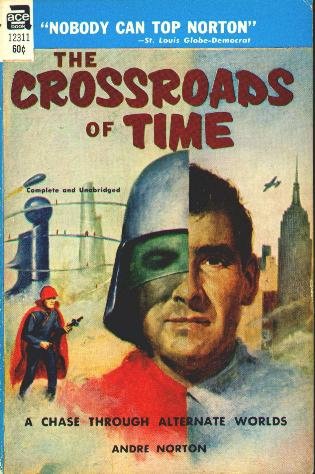
The Crossroads of Time by Andre Norton
Blake Walker is a foundling. Somehow, he had arrived in a dark alley at approximately age two, not even knowing his own name, and with no records of his previous existence. He’s probably of mixed race, with vaguely Asiatic features but dark red hair that looks black in low light. After all available search methods had been unable to find his parents or other clues, Blake was adopted by the police officer who’d found him. Just as he was reaching the estate of a man, his adoptive parents died, leaving him without immediate ties, so he’s come to an Eastern city to study art.
There’s one more odd thing about Blake. He sometimes gets hunches, warnings about danger to come and what he should do in response. He’s had one of those hunches, and is lurking behind his hotel room door, waiting for the perfect moment. At last the moment arrives, and he opens the door just in time to save a man who was being threatened by a gunman.
The man, Agent Kittson, is grateful, but puzzled. He eventually decides that he needs to take Blake to meet his fellow agents as it’s clear that their quarry will become interested in the enigmatic young man himself. It’s quickly revealed that the agents aren’t from the American government, but another Earth. It turns out that it’s possible to travel from one alternate Earth (called “levels”) to another. On their Earth, technology advanced far faster, but they were almost wiped out in a global war, and only after that did they discover the ability to shift worlds.
However, once the secret was discovered, criminals from their Earth started using the technology to seek out troubled Earths ripe for the conquest. One such criminal, Pranj, has built up a network of henchmen across several worlds, and the Wardsmen are trying to discover what his plan is so they can stop him. Oh, and both Pranj and the Wardsmen have psychic abilities, and they are pretty sure Blake does too, though precisely how this is possible is a mystery.
Having nothing better to do, and having a strong sympathy for law enforcement, Blake agrees to stay with the agents while they investigate, especially once he experiences Pranj’s painful mind probe power for himself. However, Blake is soon separated from the agents and captured by the local gangsters who work for Pranj.
In an attempt to escape, Blake and a fellow prisoner activate a crosstime device, and Blake begins a desperate flight across different levels to first evade and then strike back against Pranj.
This 1956 novel was followed by a 1965 sequel, Quest Crosstime, making it one of Andre Norton’s shorter series.
Good: There’s some cool ideas and alternate Earths looked at during the course of the story, though Blake really only catches glimpses of them. It’s nice that Blake is not a “standard white dude” though he’s close enough to pass most of the time. Later on, while it’s never directly stated, it’s made abundantly clear by clues that a heroic leader character is a Black man. (This is somewhat mitigated by use of old-fashioned ethnic terms.)
Most of the back half of the novel takes place in a world where the United States lost World War Two. It doesn’t, however, just have the Nazis win. Rather, a combination of blitzes and germ warfare devastated America, and a final mission was launched to wipe out the Nazi leadership when it gathered in London for a celebration. As far as anyone knows, that mission succeeded, as there’s been radio silence ever since.
As long as he’s stuck there, Blake decides to aid his “fellow Americans” in their struggle to rebuild after the collapse of civilization. But other than stopping Pranj (as this world is the focus of his plans), the Wardsmen must prevent Blake from interfering in local developments. “History must develop without crutches.”
Less good: Blake Walker is a rather wooden character. He has the skills and character traits needed to carry the plot forward, and that’s about it. He’s notably detached from the society he grew up in, and doesn’t have any particularly strong feelings about his life being thrown awry by the events of the story. It’s kind of a foregone conclusion that he’ll be joining the Wardsmen at the end.
Interesting: The Wardsmen and Pranj have disguise technology of some sort. One of the agents disguises himself as a woman at one point, though Blake can still tell it’s him, and with conservative 1950s fashion, it’s not clear how deep the disguise goes. It’s basically a throwaway, and we don’t see the agent having to interact with anyone as Blake is captured almost immediately thereafter.
This novel skimps on actual female characters; there are a couple of female “monsters” on one of the visited worlds, but that’s about it.
A character is called a “gunsel” by fellow criminals, probably for the same reason Dashiell Hammet put it in The Maltese Falcon.
The city most of the action takes place in is pointedly never named, though it’s on the East Coast, and has a subway.
This is lesser Andre Norton, but still interesting.
Mankind on the Run by Gordon R. Dickson
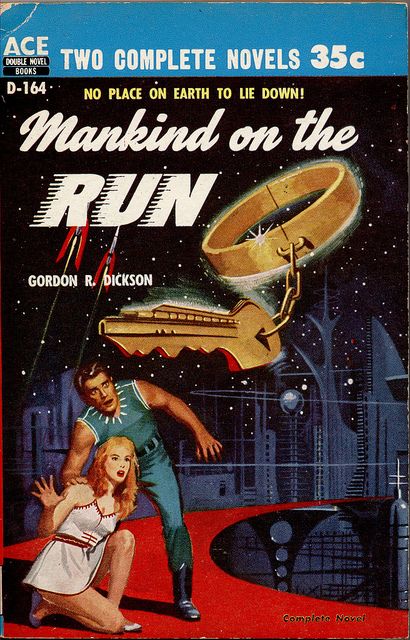
Over a hundred years ago, the world was engulfed in what became known afterwards as the Lucky War (as in, it’s “lucky” that the human race survived.) The new world order that emerged from the war decided that “nationalism” was the major thing that led to the conflict, so a new set of rules was instituted. No person could live in one area for more than six months, and that’s for a Stable Class A citizen. There’s an underclass known as the Unstabs, who are allowed as little as two weeks in one place before being forced to move on.
This is enforced with Keys, wrist-mounted devices that all citizens wear, that will only open doors that have been set to accept those Keys. No one can survive without their Key, and the Keys won’t work in a certain area beyond your time limit.
Kil Bruner and his wife Ellen are Stable Class A citizens enjoying their last night in Acapulco before they must relocate to Germany. Fortunately, as a mnemonic engineer, Kil can work anywhere. Kil and Ellen love each other very much. So it’s a shock when time freezes and a Keyless old man takes Ellen away. She’s clearly unhappy but agrees to go.
To everyone but Kil, it’s as though no time has passed at all, and no one saw Ellen disappear. Kil reports this to the local police, who are unbelieving and baffled. He’ll have to take this to the World Police in Duluth in what used to be Minnesota.
The World Police turn down the missing person case on the flimsy excuse that Ellen went “willingly” but Kil doesn’t quite twig that this doesn’t make sense. After a private detective admits he can’t handle the case, Kil is forced to try his luck in the Unstab community with their local temporary leader, the Ace King. This goes horribly wrong, and Kil gets beaten badly.
Kil’s nursed back to health by an Unstab “runner” named Dekko, who has taken an interest in Kil’s search for Ellen. His fees are quite reasonable, and Kil could use an ally.
For the first time, Kil must see the flaws in his society and the plight of the underclass. This complicates his search, as he must learn to navigate new social situations while trying to find the connections he needs to unravel exactly what happened.
Kil is a more interesting protagonist than Blake, as his intense love for Ellen gives him a strong motivation to move forward with his search even when things look bleakest and everyone around him warns that it’s impossible. He’s also got a nasty temper, a flaw that gets him in over his head more than once.
There’s some decent social commentary, as Kil is a privileged person forced to see just how much he’s relied on that to shield him from the downsides of a rootless civilization. There are people who are trying to overthrow the current social order, but unfortunately their leader is more interested in putting himself and his people in charge than in fixing things.
We also meet a couple of people who’ve definitely been done dirty by the system. Melee, a woman whose mental illness has trapped her in the ranks of the Unstab and basically gone untreated since, and Toy, a man who would have been a hero in a time that needed action heroes, but instead has to settle for being a thief. Both of them end tragically, though Toy at least gets to go out in a cool way.
The ending reveals what’s been going on behind the scenes, and Kil develops a way to resolve things that will fix his civilization. It’s kind of out of left field, with only slight clues in the buildup. And that abruptness kind of degrades the story a bit.
This was later printed on its own as On the Run. It’s got interesting ideas, but the ending really lets it down.
This is a decent enough duo of stories, but mostly recommended to fans of the authors.
