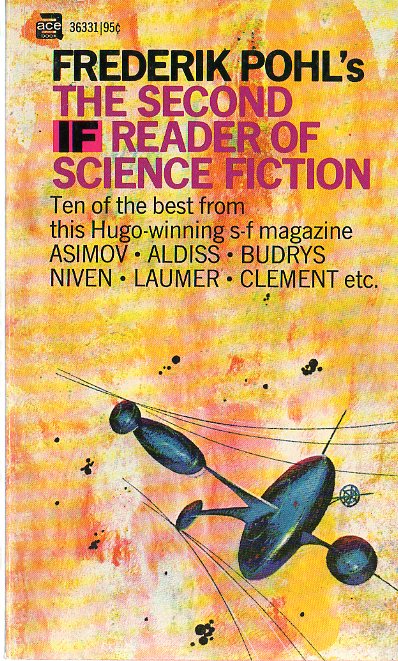
Book Review: The Second If Reader of Science Fiction edited by Frederik Pohl
If was a science fiction magazine that ran from 1952-1974, with its most successful years being under editor Frederik Pohl, winning three consecutive Hugos for Best Professional Magazine 1966-1968. Mr. Pohl has considerately included some stories from before his tenure in his second collection of favorites. He provides a brief introduction which suggests that accurate prediction is less important to science fiction than the vivid imagination of the writers.
“In the Arena” by Brian W. Aldiss starts the volume with a tale of an Earth that has been conquered by insectoid aliens. The protagonist is a pilot from one of Earth’s former colonies who’s been transported to Earth to participate in the aliens’ gladiatorial games. There’s no rescue coming–the aliens are too strong in occupation for the colonies to attack them there.
He’s done quite well for himself, and he just needs to win this one last combat to be a “free” man, but the arena’s cruel promoter changes the battle to a chained doubles match. Worse, his new partner is a woman who, while she is reputed as skilled, is a rookie. They don’t get along at first, but then the woman proves herself a good tactical thinker, and maybe they can pull this off after all.
This one reads more like an opening chapter, or at least one towards the beginning of a book. We don’t even get to the combat!
“The Billiard Ball” by Isaac Asimov sets up a rivalry between a theoretical physicist and the engineer who’s found ways of monetizing the Nobel Prize winner’s theories. This comes to a head when the physicist’s latest theory could possibly produce antigravity, but not in a commercially viable way. Or so the theoretician opines. The billionaire industrialist takes that as a challenge.
Since both of the men are avid pool players, the climax comes down to a single billiard ball. Was it an unforeseeable accident? Or murder?
“The Time-Tombs” by J.G. Ballard takes us to a long-deserted desert where the old civilization entombed their people with data tapes that recorded their personalities and memories in the hope that one day they would be resurrected in new bodies. Nowadays the remaining tombs are protected by law, but there’s still a lucrative trade in data tapes if a tomb robber can find one that’s intact.
The protagonist has fallen on hard times, and has joined a tomb robber gang, but is having strong second thoughts. Especially when he finds a tomb with a particularly haunting woman being projected by the ancient circuitry. This is a melancholy story.
“Die, Shadow!” by Algis Budrys has the first explorer to Venus develop a way of putting himself in suspended animation to survive the entry to that planet’s atmosphere. He doesn’t realize until too late that he won’t be able to reanimate himself without outside help.
He awakens millennia later, after humankind has gone to the stars. HIs inert form has been worshipped as a god, but now a new menace threatens humanity, and he’s needed to stop it. Or is he? What if his revival is exactly what the shadowy evil wants?
“The Foundling Stars” by Hal Clement leans more to the hard science fiction end. Scientists want to test competing hypotheses about the formation of new stars. Much of the story is setting up the theories and the details of how the experiment is supposed to work. There’s a perspective twist at the end.
“Toys for Debbie” by David A. Kyle, conversely, is closer to fantasy. When Debbie breaks her toys, bad things happen to the things that look like her toys. When a mysterious insurance salesman gives her a glass globe of the Earth, Debbie’s father puts it away for when she’s older and perhaps a bit less careless. Peculiar 1960s culture bit: Debbie got her picture in the local paper because it’s considered unusual that she loves “boy” toys as much as she likes “girl” toys.
“Forest in the Sky” by Keith Laumer is one of his Retief series, about an assistant in the diplomatic corps who is rather unorthodox and thus is never going to get promoted, but is the one who makes all the missions succeed. This time he’s helping Ambassador Oldtrick try to make contact with an alien race that’s somewhat like furry balloons. Problem is that the enemy empire, the Groaci, are laying claim to the planet using a cheap loophole.
This one is very action movie with Retief often in peril. It’s also a very Cold War story.
“At the Core” by Larry Niven is part of his Known Space universe. A pilot is hired by the famously cowardly Puppeteers to take a special ship capable of extremely Faster Than Light speeds to investigate the core of the Milky Way galaxy. What he discovers there may be the doom of all who live.
“Under Two Moons” by Frederik Pohl is a secret agent spoof. Johan Gull of Security is tasked with investigating a UFO cult on Mars. Are the supposed aliens the real things, or somehow linked to the Black Hats? There’s a lot of James Bond riffs in here, including the sultry female enemy agent who has the hots for Gull, and the big gambling sequence against the big bad of the story…using Monopoly. But there’s also UFOlogy and Tars Tarkas of the Barsoom books makes a guest appearance.
“Masque of the Red Shift” by Fred Saberhagen concludes the volume with one of his Berserker stories. The Berserkers are a machine intelligence left over from an ancient interstellar war. The species that created them is long dead, but the Berserkers still follow their prime directive, the annihilation of all intelligent organic life. Now they’ve bumped into the expanding human civilization, and war ensues.
As you can tell from the title, this story takes some inspiration from Edgar Allen Poe. A dictator has had his much more popular brother cryogenically frozen, though he’s let on to the rest of the galaxy that the man is dead. Also, he’s having the broken and brainwashed leader of the late rebellion brought to his space station for humiliation.
But the Berserkers consider the brother to be one of their greatest enemies due to his strategic and tactical skills. So they want to verify that the man is, in fact, dead. And they’ve been learning subtlety. The ending is perhaps a little less pessimistic than its inspiration.
None of these stories is a true classic, but they’re all pretty solid and good for their time. I enjoyed the Kyle and Laumer stories best. Many of these have been reprinted in other collections, but you may be able to find this one in a good used bookstore.
Recommended to fans of pre-New Wave Sixties science fiction.

I really like Saberhagen’s Berserker short stories. I’ve read several of the longer books, and those were ok, but mostly I enjoy the shorter works.
Good to hear!