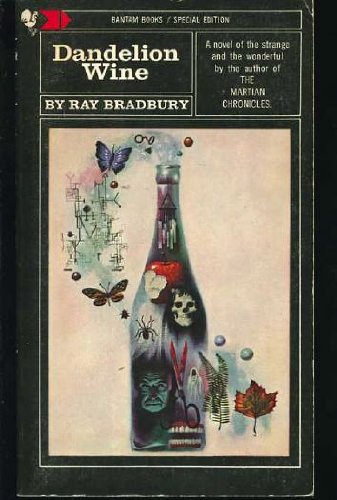
Book Review: Dandelion Wine by Ray Bradbury
The time: Summer, 1928. The place: Green Town, a large rural town in Illinois. Douglas Spaulding has just turned twelve years old, and this will be a summer to remember, the moments captured in time like dandelion wine.
This 1957 novel is a collection of vignettes, some previously published in various magazines as early as 1946, and stitched together to all be one summer. Douglas is the most often seen character, seconded by his ten-year-old brother Thomas, but the focus in individual parts is often on other characters entirely. The Spaulding family, four generations present at the beginning of the summer, run a boarding house.
Douglas is an imaginative boy and Green Town is full of small adventures, breaking in new sneakers, listening to the memories of elders, playing in the dark ravine, picking wild berries. But there is also death in Green Town. We learn in passing that Douglas and Tom have a dead baby sister. A couple of old folks pass of age. The trolley runs for the last time. The Lonely One strangles young women. Even Douglas himself comes very near death from heatstroke.
This is closest in style to what later became known as magical realism. The magic is primarily in the imagination of children and the foolishness of adults; is that an actual duel of witchcraft, or two old women letting superstition get hold of one, and practical joking of the other? The one completely fantastical thing is the Happiness Machine one of the characters builds, and that goes away very quickly. One could also make a strong case for the bottled air, which certainly seems magical.
I found this book rather thick going. Douglas and to a lesser extent Tom are very eloquent for their ages, speaking in speeches well beyond their years. And overall, this is Mr. Bradbury going in heavy on his prose poetry writing style. I do think it would make an excellent audiobook with the right narrator.
While the main protagonists are children, this is not a children’s book. It’s more for adults looking back on the magic of childhood and towards the mystery of old age. It is likely to hit very differently as one ages and learns, so may be worth a reread if you enjoyed it more than a decade ago.
Content note: Lethal violence off-screen. Very minor period racism and sexism. Children in peril. Slapstick injuries. Early teens on up should be fine.
While I can respect the craft Mr. Bradbury put into this book, and there’s a lot of ideas to chew on, I like his straight-up horror and fantasy better. Recommended to magical realism fans.
