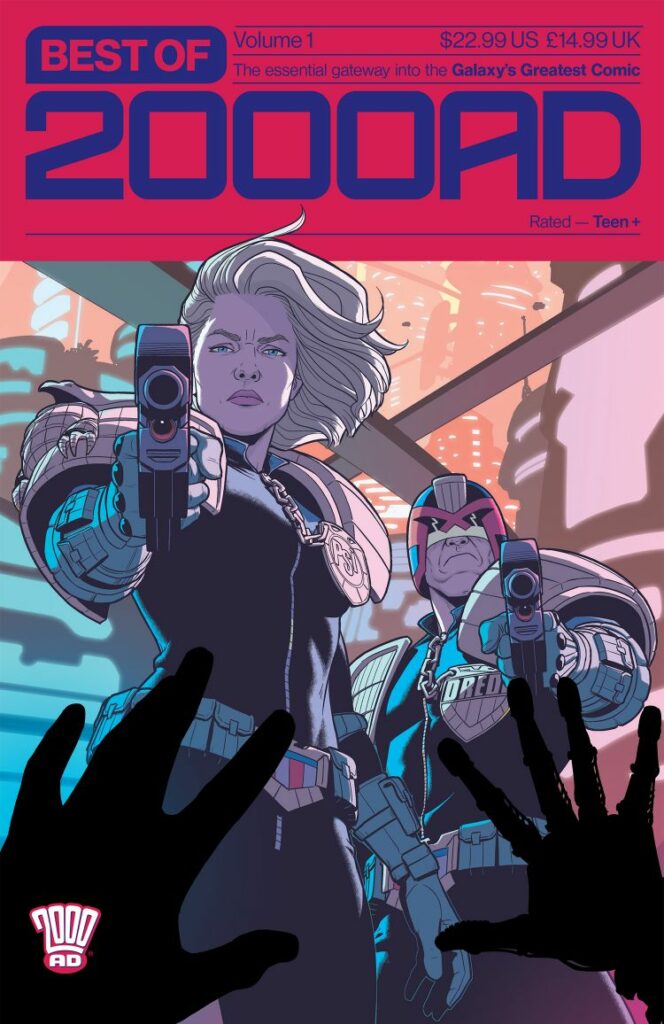
Comic Book Review: Best of 2000 AD Volume 1 edited by Tharg
The British speculative comic book 2000 AD has been running weekly since the 1970s, so there’s a lot of material they can call on for reprint volumes. This collection isn’t for a single series or creator, but what the current management thinks was the best from the past.
“Mutie Block” script by John Wagner, art by Kev Walker, is our first Judge Dredd story. Mutants had for decades been banned from residence in Mega-City One, but the restriction has now been lifted. Even though the government can’t legally keep them out, that doesn’t mean most of the people in charge actually want them there. The official greeters warn about the extreme prejudice against mutants, trying to discourage entry.
If they persist, the new citizens are housed in segregated Cit-Blocks, in this case Norma Jean Baker Block. This is to protect them from attacks by “normal” citizens while assimilation occurs. In theory, anyway. In reality, it makes it easy for hate groups to find their targets and think they can exterminate them all at once.
Judge Dredd drives by Norma Jean one cold night in search of a petty crime suspect and notices that there are no protestors, and the usual police guard has been withdrawn to deal with a riot elsewhere. Sure enough, a certain person has managed to coordinate a plan between various groups of criminals, vigilantes, militias and generate haters to attack the block.
It’s not a very well coordinated plan, but Judge Dredd is the only armed defender of the building and the mutant inhabitants for most of the story.
Sadly relevant satire of issues involving prejudice towards and violence against immigrants in real life. But with plenty of violence and explosions to keep your attention.
“Brink” script by Dan Abnett, art by Inj Culbard, is the first couple of chapters about detectives Carl “Brink” Brinkmann and Bridget “Bridge” Kurtis investigating a murder aboard a space habitat in the 2070s. Earth has become uninhabitable, or so we’re told, so the remainder of humanity now has evacuated to orbiting habitats collectively known as “the Brink.” Yes, Carl is aware this is hilarious.
They quickly connect the murder to cult activity that seems to have originated on a different habitat, so it’s time to follow the leads. Problem is, this cult may be worshipping something real and very dangerous…
This one comes across as cosmic horror, given that just saying the name of one of the “gods” causes nausea, and the nature of the threat seems to lurk under another layer of reality.
“The Ballad of Halo Jones” script by Alan Moore, art by Ian Gibson, reprints the entire first “book” of the series. Halo is a young woman of the 50th Century living in “the Hoop”, a habitat floating off Manhattan Island. Unemployment is endemic, as is violence. A subculture known as “drummers” have sonic implants in their brains to allow them to just not care how depressing Loop life is.
Halo and her friend Rodice have to go on a shopping trip to the other side of the Hoop, a hazardous journey with many twists and turns. When they return, their neighbor has been murdered, another friend has become a Drummer in despair, and Halo decides to try to escape the Hoop by getting a job. Even if this requires going off-planet.
This is an interesting setting with many inventive details, and Halo is a likeable character. The creators intended to tell her entire life story, sketched out in advance, but the series ended after three volumes due to contractual disputes. It’s available in an omnibus if you like this sample.
“The Sad Case” script by John Wagner, art by Carlos Ezquerra, is a Strontium Dog story. Due to a nuclear war in the 22nd Century, large portions of the British population were dosed with Strontium-90 fallout and many of their children were born as mutants. Most are just deformed, but a few have special abilities. Many mutants have become mercenary Search/Destroy agents, basically bounty hunters, and nicknamed Strontium Dogs.
Johnny Alpha, who has unusual eyes with special perception, is our main character. On a time-travel adventure, he met and befriended Norse warrior Wulf Sternhammer, who became his bounty hunting partner. In this story, they’re approached in a bar by Kid Knee, a down on his luck S/D agent whose mutation is that he has no head and his face is where one of his knees should be. (It’s not clear where he keeps his brain.)
Kid Knee feeds the pair a sob story, and Johnny agrees to take him along on a lucrative fugitive hunt. The Kid’s drinking habit, whining and impulsiveness result in the fugitive getting away, and Johnny promising not to work with him again. (Kid Knee would go on to be a recurring bit character, mostly incompetent but sometimes useful.)
There’s quite a bit of dark humor in this series.
“Shamballa” script by Alan Grant, art by Arthur Ranson, comes with a critical essay by Adam Karenina Sharif examining this Judge Anderson, PSI-Division story. A series of bizarre and deadly psychic phenomena striking all over the world link Judge Cassandra Anderson and her Sov-City counterpart Psikop Mikhail Amisov. In a reflection of the glasnost policies going on in the real world at the time the story was written, the American and Soviet governments allow their police forces to team up to investigate.
The disturbances turn out to be connected to the underground Deros of the Shaver Mystery, a malevolent offshoot of humanity with mental powers. The defenses against them are fading, so they’re able to affect the surface world more strongly. Soon, they will be able to rise and plunge the Earth into a war of all against all, with the Deros ruling over the ruins.
The combined team winds up in Tibet, where a ruined monastery contains answers to how to stop the Deros. But are they answers you can live with?
Meanwhile, Judge Anderson is having internal struggles with her increasing awareness that she’s a cog in an oppressive system and the fact that she keeps losing the people important to her. Are upholding the law and saving the world worth the social and personal cost?
This is an unusually layered story for 2000 AD in the time period, and has a lot to recommend it. It does have some uncomfortable undertones of Orientalism that may turn off some readers.
“Spok’s Mock Chocs” script by G. Grant, art by Hewlett Whitaker is a Judge Dredd short. It turns out that the new artificial chocolate bars put out by the title company have a one in ten thousand allergic effect. The affected rat or human becomes highly aggressive, biting anyone in range, then explodes. Unfortunately, this was only discovered after the quality tests were concluded and the candy was already on the market.
The company owner decides not to reveal this to the public as he’d be imprisoned for negligence, and he’s dying of cancer anyway. Judge Dredd promptly freezes the old man for a future cure and life in the Iso-Cubes.
Interesting, but mostly here to fill space.
“D.R. & Quinch’s Agony Page” script by Jamie Delano & Alan Davis, art by Alan Davis, concludes the volume with a one-pager starring two alien juvenile delinquents answering letters from readers.
For non-British readers, a quick glossary note. What Americans call “advice columns” were known in England as “agony pages” written by “agony uncles” and more often “agony aunts.”
This time, D.R. and Quinch answer a question about catching a milk thief (this was back when most people got their milk by door to door delivery) through their usual ultra-violent and overkill methods.
Content note: Loads of often-lethal and gory violence. While the primary audience of the source magazine is teenage boys, more sensitive younger readers might need guidance.
This is a good sampler of the type of material published in the venerable comic weekly. If you like a particular title, most of these have their own collections. Recommended primarily to science fiction fans with a high tolerance for violence.
