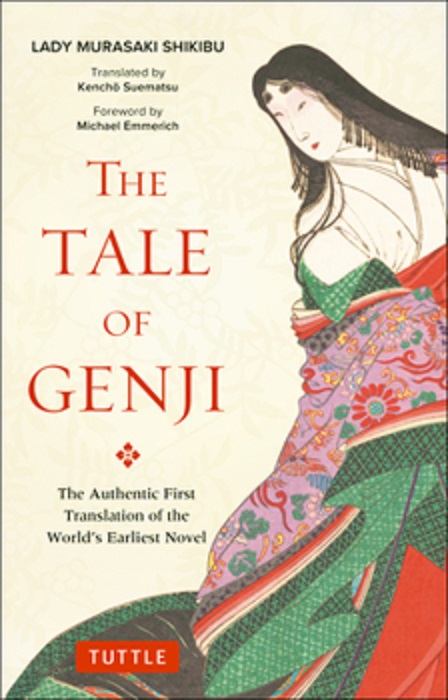
Book Review: The Tale of Genji by Lady Murasaki Shikibu, translated by Kenchō Suematsu
It is the height of the Heian period of Japan when a second son is born to the Emperor. This is the child of his favorite consort, while his first son is the offspring of his primary wife. The Empress is a jealous woman, and to prevent a succession struggle, the Emperor demotes his second child to mere nobilty, and the boy becomes known as Hikaru Genji (“shining Genji.) Despite Genji now being out of the line of succession, the Empress never quite gets over her negative feelings towards him.
Genji’s mother dies when he is still very young, so he is primarily under the care of nursemaids. He grows into a very handsome boy, and proves skilled at dancing, poetry, and other admired skills of the noble caste. He also develops a strong interest in women, flirting with and often succeeding in bedding them. But is this truly a fulfilling life?
Genji Monogatari is the first extant Japanese novel, and some scholars consider it to be the first example of a “novel” anywhere. It was written in the early 11th Century by a Heian court lady for the amusement of other court ladies, and proved to be popular enough that manuscripts of varying quality were passed down through the centuries. Thus, it’s a classic of Japanese literature.
The translation I read was the first one in English, translated by Mr. Suematsu when he was a university student in Cambridge in the 1880s. It’s only the first seventeen chapters of fifty-plus, perhaps truncated when he realized the difficulty of the work, or because he needed to return to Japan. It’s not considered the best translation–going from antique and somewhat esoteric Japanese to stiff Victorian British English, but does have its charms.
There’s three introductions, the first a foreword by a modern scholar, then an introduction from a scholar of the 1970s, and finally one by the translator himself. There’s also quite a few footnotes to explain Japanese words, customs and literary allusions.
The chapters included take us from Genji’s birth through his early romantic encounters, a period of semi-voluntary exile, and triumphant return. The earliest chapters are especially rough to get through as Lady Murasaki was clearly learning her craft from scratch. There’s one chapter that’s just Genji and his buddies sitting around and talking smack about girls they’ve courted. It’s important later, as Genji decides the only way he’ll get the perfect love interest is to start young and train her up himself. Which he does.
Also making things tricky for the reader is that almost none of the characters are identified by their actual names. This is in accordance with court etiquette at the time, but means that you have to keep careful track because some of the characters change appellations when they’re promoted in rank or change residence. Others, especially the women, just have nicknames. (This translation uses different names than some of the others, for example the in-novel Lady Murasaki is here referred to as “Lady Violet.”)
The Heian period was one of relative peace in Japan, and the courtiers spend far more time on rituals, festivities and petty rivalries than they do on actually running the country. The big event at the end of this volume is a competition to determine which of the Emperor’s ladies has a better picture collection. Genji’s side wins because while he was in exile he leveled up his painting skills.
Genji is…well, an example of how cultural norms change. He’s promiscuous, and kidnaps a little girl to train her to be his wife. (Genji’s already married, though that one was arranged, and they don’t get along well.) But he’s considered one of the good nobles because he is amiable towards his exes, and even kind to women he doesn’t want to bang.
There’s no real overarching plot, this is just a series of events in Genji’s life. Randomly there are vengeful spirits and prophetic dreams, but they’re just things that happen.
Oh, and the characters are constantly making up or adapting little poems in conversation rather than being direct about their feelings.
This is the sort of book that is well worth studying because of its cultural importance–you’ll see all sorts of allusions to it in other Japanese literature–but is a chore to get through. You might want to start with a more modern translation.
