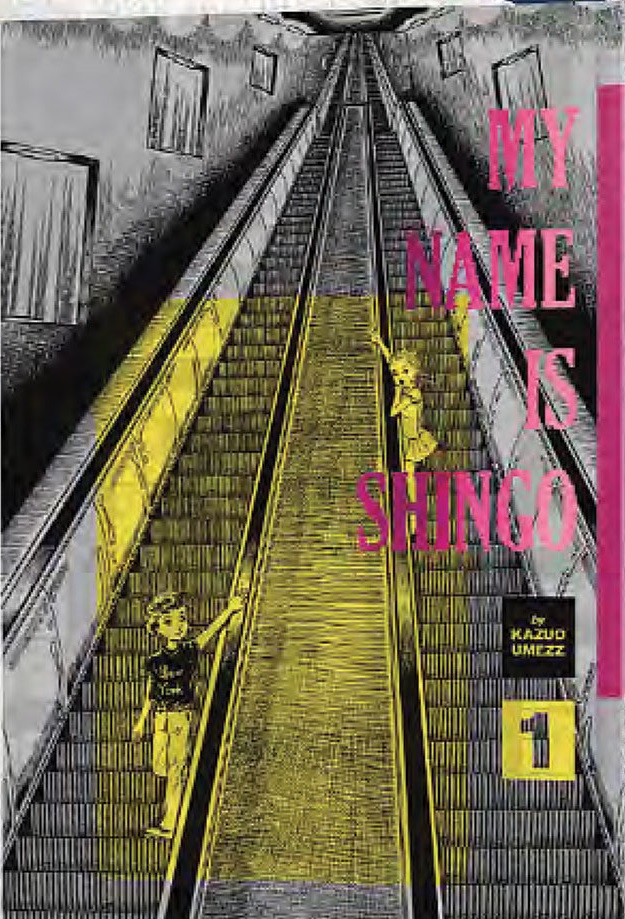
Manga Review: My Name Is Shingo 1 by Kazuo Umezz
It is 1982, and Satoru Kondo is in his last year of elementary school. He’s a boisterous boy, loud and excitable. Some of his classmates are already succumbing to heterosexual amatonormativity, but Satoru hasn’t quite reached that stage yet. His father works at a motor factory; it’s not a prestigious job that requires smarts or a fancy education, but it’s good, honest work that pays enough to live on and builds muscle. Satoru’s mother is a housewife who is probably grateful to only have one kid, as Satoru is a bit much.
One day, the owners of the factory purchase two industrial robots that the workers name Monroe and Leigh after American movie stars. Industrial robots on this scale are still an emerging technology, so the workers greet their new tools with a mixture of excitement and skepticism. When he’s informed of this development, Satoru’s reaction is pure excitement (though his ideas of what a robot is are heavily influenced by mecha anime.)
Satoru is thrilled to learn his class will be taking a field trip to the factory to see the industrial robots. While the reality shatters some of his childish delusions about robotics, it sparks a new interest in actual robotics. At the end of the field trip, another class comes in, and Satoru meets and imprints on a pretty girl named Marin.
Their puppy love is very mixed with Satoru’s fascination with Monroe, and he learns how to program the machine, imprinting it with “memories” of both himself and Marin.
All is not well, however. Now that the robots have become fully functional, several of the factory workers have become redundant, quitting or being pushed out. Especially disgruntled is an older worker named Maruoni, who becomes a scrap dealer. Satoru’s father is promoted to supervise Monroe, but it’s not going great because he has trouble figuring out the complex instructions.
This children’s manga is different from the other Umezz series I’ve reviewed. Instead of horror, we’re in the science fiction realm here, one long tale about a robot gaining self-awareness. It’s very slow burn on that front, though. This first volume is more of a coming of age story for Satoru, with the only hints of what’s to come being that the future Shingo is the narrator.
As such, the story is mostly about Satoru’s engaging in youthful shenanigans and his family life. So far, we don’t even have a grip on who Marin is when she’s not being dragged into something by Satoru.
So until the science fiction part kicks in, the main draw is the art. Kazuo Umezz and his assistants do an excellent job of providing detailed drawings of machines and circuitry.
There’s also a somewhat nuanced look at the workers displaced by the new technology and their struggles to adapt to this reality.
The Japanese title is “Watashi wa Shingo“, which tells us a bit about Shingo. “Watashi” is a gender-neutral personal pronoun, a default polite way of saying “I.” This gives us a hint of what Shingo’s personality will be, once it appears.
Content note: Shingo teases girls and pulls one’s hair. Alcohol abuse, vomit. Spoilers say that future volumes will get a lot darker. This was for kids in Japan, but…
If this were an American movie, the robot would be on the poster and in all the trailers, then audiences would have to wait through thirty minutes of cute kids and family drama before the part they came to see begins.
Again, excellent art and we can tell the story is going somewhere interesting eventually, but it’s taking its own sweet time to get there. Maybe check out the next volume first, see if you like it once the main plot starts, and then come back if you want to see the buildup.
