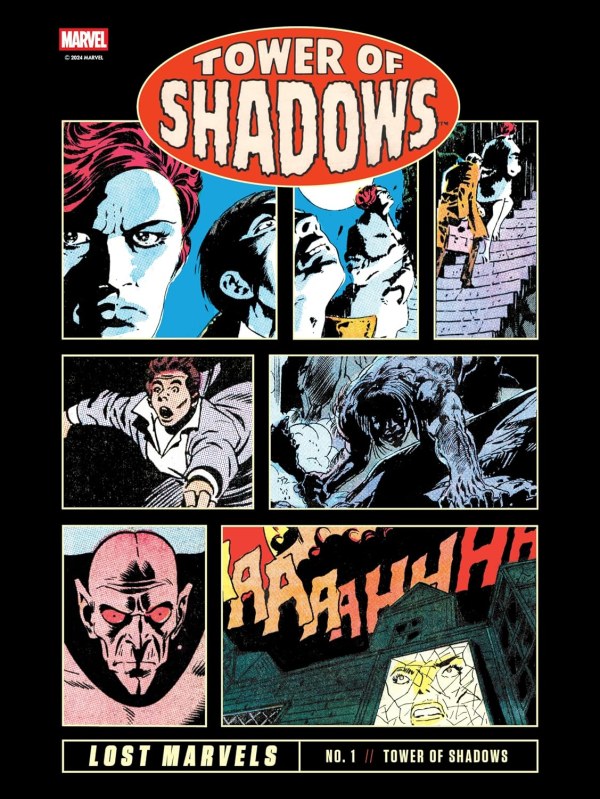
Comic Book Review: Lost Marvels No. 1: Tower of Shadows edited by Dr. Michael Dean
The “Lost Marvels” series of books reprints Marvel Comics publications that have not been previously collected in reprint volumes, looking to be mostly short-run series and one-offs that match a theme. This first volume reprints most of a horror anthology series, Tower of Shadows.
Per the editorial introduction, by the late 1960s, the Comics Code Authority had unofficially lightened restrictions on the horror genre in comics. (They’d officially modify the code in 1971.) DC Comics had been doing well with spookier stories in House of Mystery and House of Secrets, and Marvel Comics decided to follow suit with their own anthology titles, Tower of Shadows and Chamber of Darkness in 1969.
For various reasons, sales were not as good as hoped, and the series was repurposed under the title Creatures on the Loose with a more action-oriented feel. Marvel would have more success with horror-action ongoing characters like Ghost Rider.
Unlike some of the other reprint collections I’ve reviewed, this one is not the issues as originally presented. Stories that were already reprints of earlier Marvel monster comics have been skipped, and two H.P. Lovecraft adaptations had a murkier legal status than publisher Fantagraphics felt comfortable with. The latter is a pity, because I am told those were really good adaptations.
So, let’s see what did get into this volume.
The lead story in the first issue is “At the Stroke of Midnight” by Jim Steranko. A quarreling couple investigate the spooky manor they’ve inherited from a missing-presumed-dead uncle. It turns out that he’s not quite as dead as they’d hoped, but they soon might be. The story’s most notable for Steranko’s art style, which is very distinctive and carries the reader through the paneling.
Behind the scenes was a certain amount of drama. Editor in chief Stan Lee rejected Steranko’s cover, changed the title to be more punny, and did some petty dialogue changes Steranko didn’t like. The writer/artist was so angry that he never wrote a story for Marvel again, though he returned to do some covers.
Also introduced here was “Digger”, a wisecracking gravedigger who acted as the anthology’s host. He didn’t last long, being temporarily replaced by mortician Headstone P. Gravely, before the series turned to just having pictures of the artist or writer introducing stories.
The final story reprinted here is “Sanctuary!” by Wally Wood. It’s a blend of horror and the sword & sorcery subgenre. King Hamand has conquered ancient Cybernia, but his enemies are many, and not all of them human. It seems that in order to claim “rightful” rulership, Hamand had to fetch the Dragoncrown from the crypt where it lay, and the ghost within the crypt swore vengeance.
In order to fend off his foes both natural and supernatural, the king and his court wizard Abarac have built a castle, and a tower within the castle, fortified with stone and magic so that absolutely nothing may enter to harm the king. But is this actually sanctuary…or something else?
Some other standouts include–
“One Hungers” by Neal Adams, told from the perspective of a creature that eats sound…including human screams. If you liked A Quiet Place this has some similarities.
“Evil is a Baaaaad Scene” by Allyn Brodsky and Don Heck. Two hippies allow a dark sorcerer to use their pad to summon a demon. This turns out to be a bad idea all around, the sorcerer goes to the bad place, and the hippies go to Suburbia, trapped in the lives of squares.
“One Little Indian!” by Marvin Wolfman and Gene Colan has a ruthless businessman told he will die in the presence of “an Indian.” I love the Colan art, but the joke here relies on how much Native American iconography has been preserved in stereotypes completely independent of the actual people. Not everyone will dig the humor.
“The Demon That Devoured Hollywood!” by Roy Thomas and Barry Windsor-Smith also has some fine art. Arrogant actor Jason Roland has shot up to the top of the A-List by playing monsters, but is looking to move into “straight” roles as a leading man. His success has come at least partially from his mysterious makeup artist who creates the looks for the monsters. Jason stiffs the man, refusing to make his final payment. As you might expect, this time the makeup doesn’t come off.
This story would much later get folded into the regular Marvel Universe, as Jason Roland turns out to be the guy taking over a group of horror-themed villains/antiheroes (including Digger!) in a West Coast Avengers story.
“The Scream of Things” by Allyn Brodsky and Barry Windsor-Smith has inks by Vince Colletta. which don’t go as well with Barry’s art. A professor is investigating a supposedly cursed house, and gains the assistance of a young woman desperate to escape life in the small village nearby. Interesting imagery, a bit confusing (I had to reread one section a few times to grasp what the curse actually was) and unfortunate “gypsy” stereotypes.
And three other sword and sorcery tales from Wally Wood that I won’t spoiler, but are all good.
The book also has a fairly detailed biography section for all the creators involved to fill it out.
None of these stories are essential, but they do have some decent writing and excellent art, and haven’t been reprinted much so are worth revisiting. Pity about the Lovecraft adaptations.
Recommended primarily to fans of Marvel’s horror comics.
