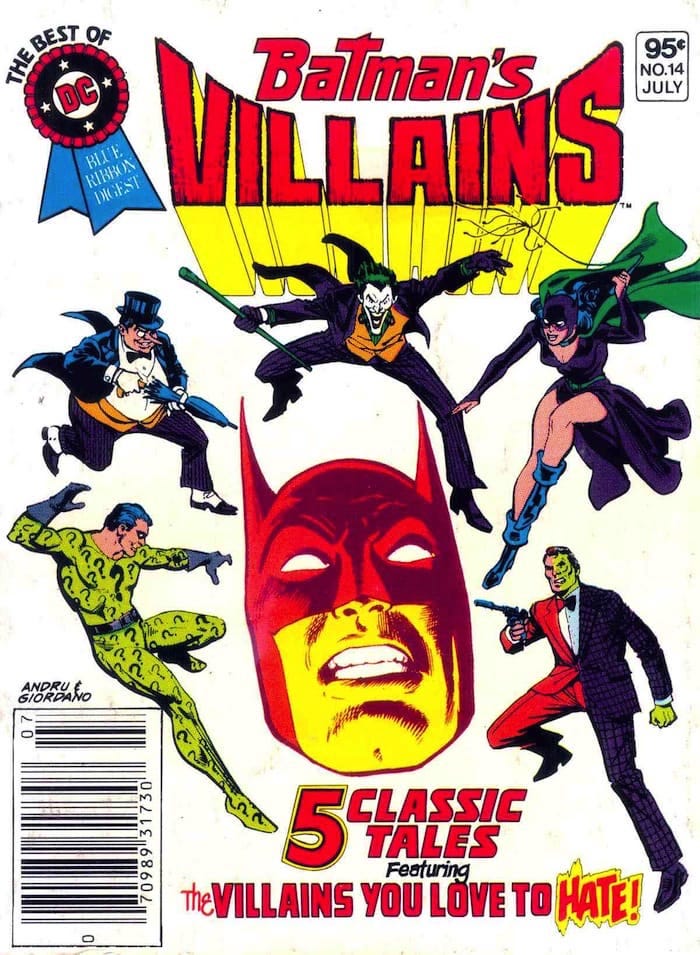
Comic Book Review: The Best of DC #14: Batman’s Villains edited by Dick Giordano
One of the things that has kept Batman a popular superhero over the many years of his existence is that he has a good rogues’ gallery, a set of colorful recurring villains that drive fun stories for the Caped Crusader. This digest spotlights five of Batman’s most prominent foes as they existed in the 1970s.
“This One’ll Kill You, Batman!” story by Denny O’Neil, art by Irv Novik & Dick Giordano, features that clown prince of crime, the Joker! We open at Arkham Hospital in New England, not yet turned into an Asylum and moved to near/in Gotham City. The Joker has somehow managed to drug the guards’ coffee causing them to laugh uncontrollably as part of his latest escape plan.
Batman shows up because of course he does, but the Joker anticipated this, and let out all the homicidal maniacs in the violent ward to distract the Dark Knight. In the ensuing melee, Batman accidentally swallows some of the drugged coffee. This is not something the Joker could guarantee would happen, but he has a plan ready to go if it did. Batman is aided against the killers at the last moment by Two-Face, who was also the informant who’d warned him of the escape attempt. Seems the “good” side of his coin has been coming up too often lately.
The effects of the drug aren’t wearing off, so Batman goes to consult Dr. Hamish, a specialist in bizarre chemicals. Turns out that the effect of the toxin will only increase over time, resulting in death. There are only two people in the world who know the antidote, Hamish himself, and a Doctor Rockwell in London. Hamish is ambushed by a trick bouquet rigged with poison gas.
Batman goes after the delivery man, who hands over a recording from the Joker. The Joker estimates that Batman has 72 hours to live, and gloats over Batman dying of laughter.
Bruce Wayne (foolishly) takes time out to visit a funeral parlor viewing for Dr. Hamish before heading to London (hey, isn’t that Oliver Queen also in the queue?). He has to leave early due to the sadness triggering his funny bone.
By the time Batman arrives in London (in the middle of fog so that the artist doesn’t have to do too much research), the Joker has already set up the abduction of Dr. Rockwell. Now Batman must track the gang to an abandoned music hall and survive the worse vaudeville humor the Joker can devise to make him succumb to the deadly laughter.
Naturally, Batman figures out how to suppress the effects of the toxin until he can rescue the doctor and get the antidote. Happy ending! Except for the Arkham guards who never got treated and presumably died off-camera, but the story doesn’t mention them.
“Half an Evil” story by Denny O’Neil, art by Neal Adams & Dick Giordano, opens with the Gotham City equivalent of the Macy’s Thanksgiving parade. A giant hotdog-shaped balloon is stolen by armed thugs.
Batman is called in by Commissioner Gordon, to the disgust of a city government person named Reeves. Reeves is brave until Batman actually shows up. The two lawmen briefly discuss the case, but are distracted by a notice that the Nautical Museum is being robbed.
The police are actually handling the visible thieves well, but Batman realizes these are a distraction and heads inside. Two clown-masked individuals are there, one throws a smoke grenade as a screen while the other one attacks. Batman easily handles the attacker, who doesn’t know who hired them, although whoever it was kept flipping a coin, and their target had been a book, the diary of one Captain Bye.
Batman instantly realizes who the man behind the scenes must be, and the audience is immediately shown that he’s right, it’s Two-Face! But what’s he up to?
Bruce Wayne recaps Two-Face’s origin for his butler Alfred. Harvey Kent used to be a brilliant district attorney and Bruce’s friend until the day he had acid thrown in his face by a mobster. The disfigurement made his mind snap and develop an obsession with duality. He uses a two-headed coin, one side scarred like his face, to determine if he will act for good or evil. Advanced plastic surgery restored his face and apparently his sanity, but an explosion set by criminals undid the repairs and he turned to crime again.
(Later retcons would have Harvey suffering from a form of Dissociative Identity Disorder that was just brought to the surface by trauma, but it hasn’t always been depicted in a way consistent with good taste or accuracy.)
Bruce consults a Marine Encyclopedia about Captain Bye, and learns that the mariner’s old ship is anchored in a marina near Gotham Bay. By the time he arrives, Two-Face is already sailing off in the ship, only to scuttle the schooner! Batman must figure out what’s really going on.
He does, and there’s a final confrontation where Two-Face’s habit of making decisions via coin flip once again foils him. There’s a particularly good close-up by Adams of Two-Face smoking a cigar in a wetsuit. It’s not really a good panel as he’s nearly crowded out by exposition, but the face is great.
There’s a double-page spread of Batman’s notable villains by Denys Cowan and Dick Giordano, followed by a key. It includes a couple of more obscure ones, Getaway Genius and Captain Stingaree, and some that have come back into notability like Mr. Freeze and the Mad Hatter.
“The Malay Penguin!” story by Steve Englehart, art by Marshall Rogers, embellishment by Terry Austin. opens with a barrel being tossed off a pier, allegedly containing the body of Professor Hugo Strange. At the time of writing, Hugo Strange had been an obscure Golden Age villain recently reinvented as an evil psychiatrist. He’d managed to discover Batman’s secret identity and imprisoned Bruce Wayne so that he could impersonate the Caped Crusader.
This had gone south on him, and he’d been captured by crime boss Rupert Thorne, who attempted to pry the secret of Batman’s true name from the professor. When this failed, Thorne apparently killed Strange and ordered his thugs to dispose of the body.
Batman and Robin (visiting from college) swoop down on the criminals, but are unable to get them to talk due to a) working for Rupert Thorne and b) Batman’s on the outs with the city government right now so the police aren’t on his side. They’re stymied for the moment.
Meanwhile, at the theater where Hugo Strange had promised to auction off Batman’s identity for money, the Penguin finds himself mostly alone with no auctioneer. He can hear the Joker’s laughter in the distance, but this meetup is a bust. Time to get back to his ongoing evil plan.
The Reed Galleries are showing a fabulous silver statue of a penguin, an obvious lure for the felonious toff. Batman tries to warn the gallery owner, but Mr. Reed is confident in his security measures.
While waiting for the Penguin’s move, Bruce and Dick Grayson check in with Silver St. Cloud, Bruce’s current girlfriend, as she recovers from her brush from Hugo Strange’s monster serum.
Batman and Robin clash with the Penguin, who gets away but drops several clues in dialogue.
Then we check in with Boss Thorne, in his cover identity as City Council President. He’s conferring with his more legitimate conspirators at the Tobacconists’ Club when suddenly he sees what appears to be the ghost of Hugo Strange. No one else sees it.
Batman finally figures out the Penguin’s real plan just in time to stop it, and Robin admires his mentor.
This story’s a bit weaker as a Penguin spotlight because it’s a subplot in a larger story arc.
“Riddler on the Move!” story by Denny O’Neil, art by Ernie Chua & Dick Giordano, focuses on E. Nygma.
Batman invades a restaurant to collar some crooks. It turns out they were there to participate in a new venture, an employment agency for criminals. Rather than rely on their own contacts, a specialized safecracker, say, could apply for job listings across the country. It’s being organized (at least in part) by the crime genius known as the Riddler.
Said “genius” calls Batman at the restaurant to give him a riddle clue. Y’see, Eddie suffers from a compulsion to give Batman clues to upcoming crimes in the form of riddles. It had started out as a pride thing, but now he’s found that he gets creative block if he doesn’t. Of course, just because he’s compelled to pose riddles doesn’t mean he’s required to play entirely fair.
The story is Batman getting riddles, escaping various traps and eventually getting ahead of the Riddler and capturing him. There’s a couple of cute moments where Eddie interacts with civilians and shows his obsession with riddles in a less lethal manner.
It’s a fun story, and the one I like best of this volume.
“The Curious Case of the Catwoman’s Coincidences” story by Denny O’Neil, art by Irv Novick and Dick Giordano, starts on a train that is carrying several prisoners, including Selina “Catwoman” Kyle, to state prison. Also aboard is wealthy playboy Bruce Wayne, who is playing backgammon with another passenger. They’re interrupted by a Roma fortuneteller (using the outdated terminology) who warns Wayne that his stars are in “cross-conjunction”, which will cause a wave of unlikely and possibly fatal coincidences.
The fortuneteller is apparently genuine and disappears from the story, but Bruce Wayne is not here by coincidence. He knows Selina is likely to arrange some sort of escape attempt, and plans to thwart it as Batman.
Enter the first coincidence. The brakes fail on a CATerpillar tractor, causing it to roll onto the tracks, causing a trainwreck. All the guards are kayoed, and Selina also takes a blow to the head, but the other prisoners are ready to escape (none of them were restrained in any way!)
Batman is able to corral all the escapees except Selina, bogged down with fighting them while she wanders away with a concussion. By the time her head clears, she’s considering going back and surrendering, as she’d intended to serve out her sentence and get clean with the law. But it’s at that moment that one of her old henchmen drives by and picks her up, eager to work with Catwoman again.
Soon she’s back to her old tricks. Batman sets a trap by disguising himself as a fabulously wealthy but vulgar society matron loaded down with jewels. The coincidences keep coming as a completely different cat burglar tries to rob who he thinks is a helpless victim.
Eventually, though, the coincidences turn against Catwoman, and Batman is able to nab her.
Each story also comes with a one-page origin story for the spotlighted villain, establishing their 1970s backstories and status quo. In the forty-plus years since, some of them have changed quite drastically.
This is a nice time capsule of a particular era in Batman continuity. All of the stories have been reprinted elsewhere, so this particular digest is recommended primarily for completists.
