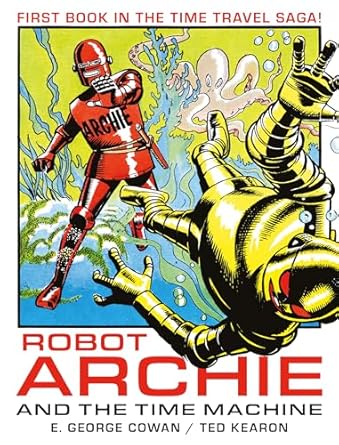
Comic Book Review: Robot Archie and the Time Machine story by E. George Cowan, art by Ted Kearon
Robot Archie was created in 1952 for Lion, a British weekly comic paper. Initially appearing in the serial “The Jungle Robot”, he was built by Professor C.R. Ritchie to help his nephew Ted Ritchie and Ted’s chum Ken Dale search for treasure in Africa. Standing about seven feet tall, painted red, and with his name printed in black letters across his chest, Archie was at this point a remote-controlled automaton.
After many adventures, in 1966 Archie was granted a new “automatic” mode (that is, free will), and a voice. He promptly started treating Ted’s orders as suggestions and developed a boastful personality. While Ted’s transmitter was still able to sometimes override Archie’s will, this was a temporary measure at best. Archie became the effective leader of the trio.
In 1968, Archie worked with Professor Ritchie to create a time machine called “the Castle” due to its resemblance to a rook chess piece. Under instructions from the Professor, he took Ted and Ken on the vehicle’s maiden voyage, a hop to the Fourteenth Century.
While there, the trio becomes involved in a struggle against the wicked lord, Hugo the Black Wolf.
Once that is settled, it’s time to go back. Ken and Ted aren’t too keen on the fact that only Archie knows how to fly the Castle. And it turns out some of the navigation equipment is malfunctioning. So this time they land in London, but not as they know it.
It is *mumble* years in the future. London is in ruins and now has a tropical climate, complete with sub-Saharan African wildlife. This turns out to be down to an alien invasion. The aliens themselves were unable to take Earth’s atmosphere, but they have left their robot army, the Superons, in charge. The remaining free humans are living in the Underground.
This is a much fairer fight for Archie, as these robots can, in fact, damage him if they actually manage to hit. Good thing they have one strategic weakness that makes it possible to defeat the Superon threat and free humanity.
Next up is a visit to the Eighteenth Century, which has Archie becoming a highwayman. But don’t worry, he’s only doing crimes to expose the real villain, a corrupt magistrate!
Each of these storylines takes place in several three-page installments. The volume is filled out with two longer stories from annuals. In one, the Castle lands in pirate times, and Archie first battles Blackbeard and then assists the English buccaneer against the Spanish. In the last story, it’s prehistory, with a dinosaur and primitive humans trying to sacrifice the Castle to their fire god.
Robot Archie is a fun character, brimming with self-esteem that honestly is kind of justified given he’s super-strong, nigh-invulnerable, can fly for short distances, and can become magnetic at will, among other useful powers and gadgets. His one weakness is that every so often one of his fuses or internal circuits will malfunction, making him go berserk until Ted can repair him.
Ted and Ken are basically sidekicks who used to be the heroes and aren’t entirely comfortable with that. They keep shouting orders at Archie, even though they are aware he has free will. Ted is at least useful when Archie needs a quick repair, while Ken is a sourpuss. They spend a lot of time getting captured or threatened so Archie can rescue them.
There’s no romantic subplots in these stories, but plenty of action. Indeed, women barely appear, and Ted and Ken do all the dude in distress stuff. At least in this volume, we never see Professor Ritchie or find out why he wanted Archie to go time traveling. Maybe Archie just insisted because he really wanted to. (Perhaps he’d seen a few episodes of Doctor Who?)
It’s not clear if the Warren Publishing character the Rook, who travels through time in a “Time Castle” that also looks like a chess piece, was inspired by Robot Archie’s adventures, since in 1977 most American comic book creators didn’t have a lot of access to British comics.
The violence is comic book stuff–Archie roughs up a lot of people but never kills one that we’re told of, and the tiger he wrestles at one point is probably fine. On the other hand, he has no compunction about smashing or disintegrating other robots. (He also has zero worries about altering history.) There’s some mention of torture, but this was meant for British schoolboys, so American kids about eight and up should be fine.
The writing is fast-paced and exciting, but don’t look for anything but the shallowest of characterization. The art is serviceable and reproduces well, and the time travel gimmick lets the artist show off his knowledge of clothing design and thoughts on alien robots.
Recommended to boys and men who are big fans of robot protagonists and/or time travel adventure stories.
