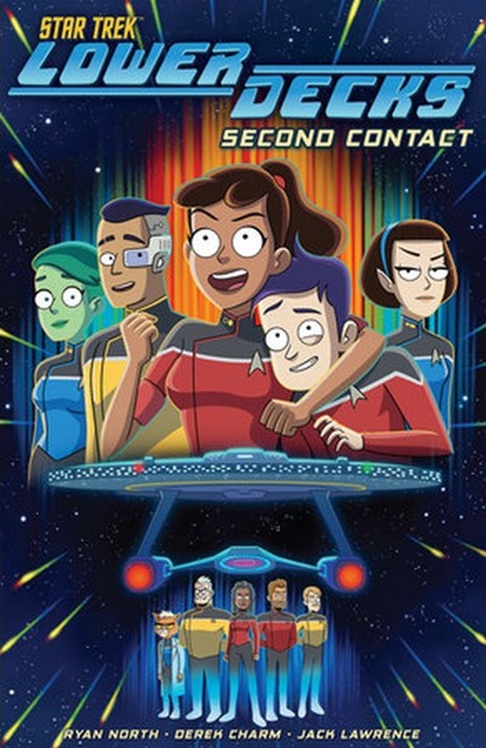
Comic Book Review: Star Trek: Lower Decks: Second Contact written by Ryan North, art by Derek Charm & Jack Lawrence
Even in the Federation Starfleet of the 24th Century, not everyone gets to explore strange new worlds, meet new civilizations or go boldly where no one has gone before. These are the adventures of the starship Cerritos, a California-class ship assigned primarily to less exciting tasks such as “second contact.” And to press the point home, we’re concentrating on the lives of the ensigns on the “lower decks” doing the mundane tasks that need to be done even in science fiction.
Or at least we start the series with four ensigns. The brash human Mariner, nervous probably human Boimler, chipper cyborg human Rutherford and sweet Orion Tendi. Despite their many foibles, especially Mariner’s recklessness and disdain for rules, they’re actually pretty competent and eventually get promoted to lieutenant JG status, and are joined by T’Lyn, a Vulcan who is very emotional…by Vulcan standards.
While the Cerritos may seem like an unimportant ship with non-critical missions, it becomes something of a magnet for bizarre events. Thus the lower decks crewmembers get to have lots of adventures.
The Lower Decks animated series ran five seasons, starting in 2020. It spawned spin-off comic books, the present volume being the first of the second series.
We’re somewhere between the fourth and fifth seasons. The first storyline kicks off with a series of crises…that are resolved within twenty minutes because this crew is competent and there are procedures in place. This irritates Mariner who is looking for a bit more adventure in her life. Even an encounter with a nigh-omnipotent child alien gets cut short when its parents show up almost immediately.
Just as the lower decks crew is about to resort to a holodeck session for some excitement, the Cerritos comes across something new. A seemingly abandoned Federation ship, the Bonaventure. It was one of Starfleet’s earliest vessels, which disappeared on its third mission. Then briefly found by the U.S.S. Enterprise under Captain Kirk. In the Delta Triangle. (There’s some byplay as Dr. Tana, the Caitian medical officer, who has never bothered to learn all the Earth history references, tries to get a non-reference answer as to what it is.)
This is a callback to the animated series, when the original series crew found the Elysian dimension, a pocket in space-time where no one ages, but it was nigh-impossible to escape. With the reluctant help of a Klingon ship, they were able to get out, but we learn that the Delta Triangle was marked as a navigation hazard and the Federation never went back to check up on the people still trapped inside. (The Federation and Starfleet’s tendency to not follow up once the crisis of the week is over is a running theme in Lower Decks.)
Anyhow, it appears that at some point the Bonaventure managed to escape Elysia, but now it’s headed on a course for Earth’s solar system at sublight speed, and with no life signs on board. The lower decks team volunteers to join the away party to investigate what happened.
Once on board, the away team gets some information on how the Bonaventure‘s crew was able to get their ship out of Elysia, but nothing on what happened to them afterward and no clue as to how long ago this was. However, once the engineers on the team restart the engines, the ship immediately goes into warp drive, with the warp core about to go critical.
And then everyone on board except first officer Ransom disappears.
Turns out that the lower decks group has been taken into a pocket space created by the Excalbians, the mineral-based life forms that once tried to understand the concepts of “good” and “evil” by having Kirk and Spock team up with Abraham Lincoln in a battle to the death against Genghis Khan and Kahless. This time, the Excalbians want to learn about the concept of “mentorship” by teaming up with five classic Star Trek characters…who will mentor them in a battle to the death.
How will our heroes get out of this one, preferably alive?
Next up, the crew has an adventure with less Captain Kirk references when the ship encounters a “vacuum collapse” caused by a new universe coming into existence, using the concept of metastability. As a result, the new universe is rapidly expanding inside the current one, which will result in it destroying all known life.
Attempts to deal with this are complicated when Rutherford and Tendi are possessed by energy beings from the new universe that don’t want it to be destroyed to protect the old one.
The final story starts with the crew of the Cerritos being ordered on shore leave while the ship has a baryon sweep. Except that Mariner knows they’re every five years, and the last one was only a year ago. Also, the senior staff has been invited to a private meeting function. Naturally, Mariner can’t resist sneaking in to eavesdrop.
It turns out that there’s someone meddling with the timestream. The Department of Temporal Investigations can’t send any of the more famous crews as the meddler would already be watching them. Therefore, they’re deputizing the senior staff of the Cerritos, who punch well above their weight class in terms of competence, to use a smaller ship equipped with time travel to go back and stop this person or group.
Mariner goes to inform her friends of this, and they head up to the Cerritos so that Tendi can fabricate some anti-tachyon field emitters that will protect them from any further changes to the timestream. Shortly after donning these devices, the timeline shifts to one where the Ferengi have taken over the Cerritos and “broken” the crew. That’s…not a good sign.
It’s decided that the lower decks group will need to travel to the past in order to assist the senior staff and put the timeline right. Except how to do that? Mariner and Boimler have a way from the time they crossed over with Strange New Worlds, but how are they going to get there?
Steal the ship! And they proceed to do so, despite the timeline rapidly switching realities around them. And also looking for the unobtanium they need to power the travel.
Of course, even if they do manage to go back in time, they may discover that the cause of the changes is more personal than originally thought.
I actually haven’t seen most of the cartoon, but the comic book seems pretty faithful.
One of the things I like here is that while the series is comedy, and makes a lot of fun of the various Star Trek series that have gone before, it doesn’t descend into the sheer crassness of many “adult animation” series. The Federation’s ideals are still important and valued. Violence only solves problems sometimes, and often makes things worse, so non-violent solutions need to be sought out. Even if sometimes our friends, loved ones and co-workers exasperate us, we still need to cherish them.
Over the course of the show, both Mariner and Boimler have considerable character development, and Mariner’s is specifically called out in the final story.
Even the stories that aren’t directly based on previous Star Trek lore have plenty of small callbacks and continuity nods. I also like the little comments at the bottom of most pages with additional information or snark.
Of course, since the comic book is taking place “between” episodes of the animated series, there can be no permanent changes to main characters or setup. Think of them as filler episodes if you like.
Since the comic book is aimed at slightly younger readers, Dr. Tana’s swear words are censored, and the violence seen is non-lethal. There is discussion of death and some beings do die off-page.
I’d recommend this book to Star Trek fans, especially ones who have seen the cartoon.
