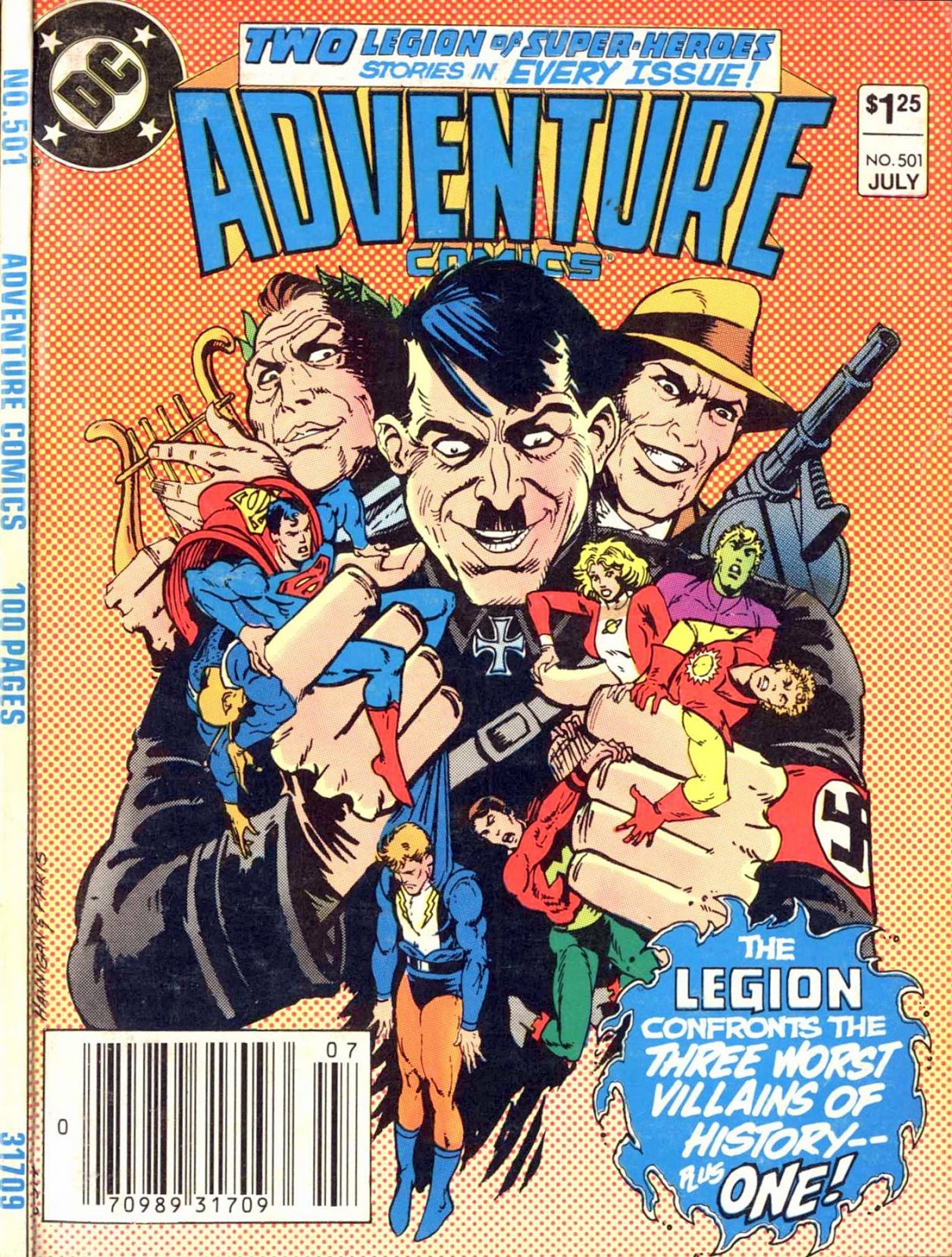
Comic Book Review: Adventure Comics #501 edited by Nicola Cuti
After the all-Legion issue #500, the digest-sized Adventure Comics returned to featuring multiple characters. Let’s see what it has to offer!
“Codename: Pinkeye!” story by Martin Pasko, art by Joe Staton & Bob Smith, picks up right after the killing of foreign agent Dmitri Dervish. Woozy Winks is worried that the person who perpetrated the crime might try throwing a dagger into him too, but Plastic Man reasons that since the “component” that Dervish was trying to steal is gone, so is the killer.
Back at the City Ballet Center, Plas and Woozy search Dervish’s dressing room for clues. Earlier, Plastic Man had heard the ballet dancer plan to double-cross his “boss” and if the boss had overheard that, well… They find a cassette player that had recorded that very conversation, and playing that attracts a young woman to the room.
This is Trixie Vixon, Dmitri’s…close…friend. She identifies the second voice on the tape as Alex Pinkus, who also claimed to be a friend of Dervish. An odd man, he always wore sunglasses indoors at night, and an unusually long hairstyle and mustache. He was secretive and preferred to meet with Dmitri in private.
After a stopover at NBI HQ, Plas and Woozy head to the Acme Hilton, where Pinkus is registered. But his real name is Alexei Pinkovski. He’s a Balkan physicist who defected to the United States some years ago, then disappeared. They find “Pinkus” in the closet, his eccentric appearance revealed to be a disguise.
When Pinkovski arrives at the hotel room, we learn that this is because he’s actually an albino with white hair and skin, and bright reddish-pink eyes. He contacts the “Inner Council” to report that he has successfully constructed a SALSER weapon and committed the blueprints to microfilm for transmission.
Codename: Pinkeye spots Woozy’s hiding place and battles the heroes while confessing to his crimes, as one does. The Super Amplified Light created by Stimulated Emission of Radiation is ten times more powerful than a comparably-sized laser. Plas wisely does not want to test whether it could actually hurt him, so he tricks Pinkeye into letting go of it. The albino also knows karate, but Plastic Man is functionally immune to blunt force trauma, so that avails him nothing.
There’s a closing scene where Plas makes a terrible pun.
“The Super-Villains of All Ages!” story by Ed Hamilton, art by John Forte, is our first Legion of Super-Heroes story in this issue. We start with the Legion checking the security of their headquarters by having a robot fall foul of the various measures. Then it’s time for tryouts! The first applicant is Ron Karr of Neptune, whose ability to make himself flat just isn’t very impressive. (He would go on to become the “…and Zoidberg” of the Legion of Super-Villains.) Also trying out is a scientist named Alaktor who’s invented a “Marvel Belt” with various cool functions. This falls under the “no artificial powers” ban, so he’s rejected as well.
Alaktor isn’t too upset, as the powers of his belt were only a distraction from its real function, sensors to detect all the security devices in Legion HQ. This is the first step in his master plan.
The Legion then heads out to Lost World, a rogue planet currently passing through Sol’s solar system. Its people are long-vanished, but they left behind their advanced technology, which could be used as weapons by the unscrupulous. It’s currently being guarded by Superboy, Mon-El and Ultra Boy, the Legion’s three most powerful male members. This is new for Ultra Boy who previously only had his penetra-vision mentioned as a power. The plan is for these three to guard the planet until it moves away from inhabited space and is lost in the vastness of the universe.
While the Legion is away, Alaktor is able to penetrate their security and make it to the Time Bubble. He failed to notice the passive recording of anyone in that room, and the Legion rushes back just in time to see him vanish into the time stream. Saturn Girl is only able to pick up that Alaktor plans to unleash the greatest evils in history. They’ll have to quickly construct another Time Bubble to go after the wicked scientist.
Alaktor’s first stop is Ancient Rome, to pick up Emperor Nero. This version of the notorious ruler is, in fact, guilty of burning Rome. Alaktor hops ahead to 68 A.D., when a rebellion is driving Nero out of Rome. He offers to save the man’s life in exchange for service, which Nero accepts.
Next up is 1934, to pick up notorious bank robber and killer John Dillinger. He’s crashed his car while being pursued by the police, and also agrees to Alaktor’s bargain.
The Legion has finally finished making their backup Time Bubble, and use Saturn Girl’s telepathy as a way of detecting which era Alaktor has gone to. They catch up to him in 1945 Berlin, where Adolf Hitler is heading to his bunker as the Allies enter the city. Alaktor is able to convince the dictator to join his squad, and the Legion has to jink in time to avoid accidentally crashing into some American planes.
The pursuit leads back to the Thirtieth Century.
Alaktor’s first plan is to introduce himself and his three henchmen, disguised under identity-concealing hoods, to the guardians of Lost World in hopes of bluffing them into surrendering. There’s some continuity glitch, as when Saturn Girl shows up, she can’t figure out who the mystery figures are, even though she already knows who Alaktor picked up from the past.
Naturally, the Legion refuses to stop guarding Lost World, though they do ask that if worst comes to worst, the villains spare Saturn Girl’s life. This allows Alaktor to show off his sexism “what do I care if a mere female lives or dies?”
The scientist then moves on to his actual plan, using a device called the Psycho-Changer to project the personalities of the three most evil criminals of all time into the minds of the three most powerful Legionnaires. Superboy is now Hitler, Mon-El is possessed by Nero, and Ultra Boy is dominated by Dillinger.
The next step is for the three evilized Legionnaires to assist Alaktor in gathering weapons from Lost World so that he can conquer the universe. It’s at this point that his plan hits a snag. Now that Hitler, Nero and Dillinger have these invulnerable, superpowered bodies, they don’t need to kowtow to Alaktor. They make him a prisoner. Seriously dude, never trust a Nazi.
Then the other members of the Legion have to find some way to battle their three strongest members to keep them from using the technology of Lost World to conquer the universe. It turns out to be easiest just to get the three villains to turn on each other. It’s mentioned that Ultra Boy is vulnerable to “radioactive force”, which was dropped at some point when his weakness was changed to be only able to use one superpower at a time.
The chastened Alaktor returns the minds to the proper bodies, the past criminals are returned to face their historical dooms, and the Lost World is shoved into a cloud of dark matter, never to appear again.
That was a wild ride of a story. One can certainly quibble about the three historical villains and their characterization, but the premise is nifty.
There’s an uncredited pinup of Ultra Boy, looks vaguely like Wally Wood art.
“Captain Marvel and the Chameleon Stone!” (uncredited) has a framing device of an old man in India telling children a story as he draws pictures in a box of sand. Inside an oval, he draws a crude lizard-like shape. He explains that the story starts in the home of noted archaeologist Cranshaw Jeffers.
Jeffers is showing off his collection to a fellow named Ravar. His most unusual item is the Chameleon Stone, an oval rock with a lizard-like shape painted on it. He found it in a Babylonian wizard’s tomb. According to legend, the stone can become anything the owner needs if one touches the picture of the chameleon while wishing for the shape desired.
Ravar scoffs, putting his finger on the stone and jokingly asking for a diamond. The stone becomes a diamond with a picture of a chameleon on it. Ravar realizes that Jeffers never bothered actually testing his magic rock. Consumed by greed, he shoots Jeffers and steals the chameleon stone.
Boy radio announcer Billy Batson happens to be walking on the sidewalk and hears the shot. Turning into Captain Marvel, he arrives just as Jeffers names his killer. The Big Red Cheese flies in pursuit, but Ravar turns the stone into a powerful light that blinds Cap. He then turns it into a car to get away.
Captain Marvel doesn’t have supersenses as such, but does figure out what kind of car it is from the sound of the motor and that he can clearly hear Ravar brag about the power of the Chameleon Stone. He begins a search of the city.
Ravar decides to have the car parked while he lays low. The parking lot attendant accidentally touches the chameleon picture on the door while wishing he were still flying a plane as he did during the war. He can’t fully control the sudden flight of the plane at this low altitude in the city, and Captain Marvel is forced to land him on a building.
While the attendant is trying to explain his wild story of a car that turns into a plane to Cap, Ravar overhears and heads for the plane. He takes off while everyone is distracted, and once far enough from the city, turns the plane into a parachute. Then he turns the stone into a fine mansion.
Some time later, Billy learns that a mansion has suddenly appeared in the remote San Drako mountain range. He decides to investigate.
Meanwhile, Ravar is growing lonely and bored in his fine mansion with no servants or visitors. He comes up with a plan. He turns the stone back into a rock. He reasons that if he breaks the stone into smaller pieces, each with the same power, he’ll be able to use it for multiple things at once.
Captain Marvel arrives in the San Drako area, and notes there’s no mansion to be seen. Then he hears a horrific scream. When he investigates, Cap finds Ravar dead on the ground, seeming dead of fright, but with a black chameleon brand burned into his forehead. What happened? Our hero will never know, and according to the old man in India, it’s beyond his understanding as well.
One of those stories where the hero is kind of superfluous.
“The Ghost That Haunted Money!” story by Gardner Fox, art by Jerry Grandenetti & Murphy Anderson, starts with a would-be bank robber being killed in a shootout with a guard. Which would be the end of the story, but we’re in Gateway City, home of the Spectre.
Frankie Barron dies consumed with a need to finish the job of stealing the money. As a result, his ghost is unable to move on, but he’s unable to touch the money to take it out of the bank. On the other hand, he can control the money enough to prevent anyone else from taking it out either. The cash is staying until he can figure out a way of stealing it.
Police detective Jim Corrigan can see the ghost, but can’t touch him. It’s time to call in his ectoplasmic partner, the Spectre! The Spirit of God’s Vengeance learns that Barron has partnered with two ordinary robbers. They’ll blow open the vault and prop open the outer doors so that Barron can psychokinetically whoosh the money out of the bank and to his hideout.
Now, the simple approach would be to allow this plan to succeed. Once Barron’s ghostly goal is satisfied, his Earthly ties will evaporate, making it easy to send him on to the afterlife. Then the money is returned to the bank, the accomplices go to jail, happy ending. But Corrigan is too much of a cop to allow even a temporary triumph for crime. The Spectre will have to find another way to deal with Barron.
After shenanigans, this turns out to be accomplished by beating Barron up with the pyramids, eagles and numbers off the cash until he can’t stand the sight of money anymore and that frees him to pass on.
The heroes come across as kind of mean-spirited in this one, perhaps the Spectre was already looking forward to running criminals through bandsaws.
“The Ray” by Lou Fine (under the name E. Lectron) doesn’t have any additional title. “Happy” Terrill is a reporter who got struck by lightning while pursuing a story in the stratosphere. Somehow this gave him amazing light-based powers.
We catch up with Happy chuckling as he reads a newspaper article offering a monetary reward for information about his super alter ego. His editor castigates his laziness, ordering him to check into a string of ship sinkings in the area.
Happy has already been investigating the matter. Dock Commissioner Jennings had an insurance interest in the cargoes of the sunken ships, and his bank account has been rising by a suspicious amount of money lately, plus the man hasn’t exactly been pressing the insurance investigation.
Meanwhile, down in the dock district, a strange figure dances along playing a clarinet. The bums and dock hands are helpless to resist the emotional effects of the music. The mad musician Stradivous exults in his power. The authorities will never suspect him, a simple artist living in an attic apartment in the slums, of being the master of deadly song.
But Jennings is waiting at the artist’s humble abode. He’s learned of a secret shipment of gold, and although he doesn’t understand Stradivous’ power or fully trust it, he’s willing to exploit it. What neither of the criminals know is that Happy trailed Jennings here and is following them to the abandoned lighthouse they use in their plans.
The former lighthouse has been secretly converted into a powerful radio transmitter. The plan is for Stradivous to contact the radio operator of the ship, hypnotize him into turning the receiver up so the music can be heard all over the ship, and cause the crew to crash their boat onto the rocky shoals.
Happy turns into the Ray and heads out to sea. He uses his light powers to cut off the electricity of the ship, silencing the radio and stopping the engine. The crew is disturbed to learn where they’re heading, and the Ray advises them to get the engine running again to steer away from the rocks.
Back at the lighthouse, Happy has gone back to his civilian guise to infiltrate, but is spotted by a guard. He easily overcomes this fellow, but Jennings pulls a gun and Happy is captured. Stradivous decides to use his clarinet to force the reporter to commit suicide, but his transmitter is still on, and it catches a police boat, which heads towards the lighthouse.
The police searchlight beam happens to hit Happy through the window, turning him back into the Ray just in time. He smashes the transmitter, then goes looking for the criminals. There’s a second, much tougher guard who slows the Ray down. Jennings and Stradivous think they’ve escaped, but the policemen from the launch have landed and tommygun them. (It’s not actually said they’re dead, but come on.)
The Ray uses his power to shine from the lighthouse to give the police a safe voyage back to shore, but this delays Happy enough that his paper is scooped by every other one in town.
The Ray ran from 1940-1943, best remembered for the Lou Fine art. He was revived along with several other Quality Comics characters as part of the Freedom Fighters in the 1970s, and versions/replacements of him usually appear in their lineup.
“As the Seas Die” written by Steve Skeates, drawn by JIm Aparo, opens in Alaska as a mysterious scuba-suited figure infiltrates a building, knocks out a guard (we learn later that the guard died), and sets a bomb, blowing up the building.
Some time later, Aquaman and Aqualad encounter a mixed school of fish, itself unusual, but also they are suicidally aggressive. The Sea King and his sidekick are more hindered by numbers than the actual attacks as the fish are also much weaker than they should be.
They are aided by the arrival of a mysterious scuba-suited figure driving an underwater skimmer. This turns out to be Phil Darson, who we last saw in the cave of slow time giants, a couple of weeks ago in story time. He’s on vacation for a little hunting, but his attention was drawn by the unusual aggressive and dying fish in the area.
Aquaman is here because he was contacted by oceanographer Professor Davidson, who lives nearby. He and Aqualad wish Darson good luck on his hunt. The professor explains that the dying fish are exactly why he messaged Aquaman. He’s pretty sure that some of the factories nearby are dumping chemical waste into the ocean, but they’ve been stonewalling his investigation.
Of course, part of the reason they’re wary of strangers is because someone blew up a factory recently. Given their wariness, Professor Davidson thinks an underwater investigation is the way to proceed.
Before the aquatic heroes can get a rest, they hear an explosion. The old Leland factory is not that far away. Aquaman spots the saboteur diving into the sea, but doesn’t get a good look, and the bomber manages to stun Aquaman with an explosive missile.
Over at the new Leland factory, the owner claims to a reporter that the explosions are boiler malfunctions. His minion points out that it’s a very thin story, but Leland wants to avoid an official investigation that might reveal his illegal chemical dumping. The minion suggests maybe stopping the dumping, but doesn’t have a less expensive plan for dealing with the waste. Leland cares only for money and disdains the environment.
Back in Atlantis, Ocean Master (Aquaman’s evil half-brother who thinks he should be ruler instead) shows up and demands to speak to Aquaman. Mera tries to get information out of him without revealing that Aquaman is away, but Ocean Master, though insisting his purpose is peaceful because he needs help, will only speak to his brother.
Aquaman finds some circumstantial evidence that makes Professor Davidson look guilty, but no, it’s Phil Darson. When he had earlier asked Leland to stop dumping the chemicals, the factory owner had refused, so Darson decided the fastest way to fix the problem was blowing up the factories. He and Leland end up killing each other.
Aquaman reminds us that it’s never right to kill to get your way, and there must have been some way within the legal system to achieve the goal of stopping the pollution. Off-panel, he talks to the new owner of the Leland factories, who agree to stop the dumping. Somehow. Time to head home!
“The Legionnaires Super-Contest” (no credits) guest stars the Legion of Substitute Heroes. Since the Universe-Monitor shows no crises currently happening, the Legion of Super-Heroes heads off to the Galactic Law Enforcement Conference, relying on remote monitors to alert them if anything happens.
However, it turns out that the monitor signals are easy to hack, and a hostile alien species does so that they can attack Metropolis and steal all its glass. (This species can somehow turn glass into a deadly chemical weapon, so no one will sell them the substance and they’ve exhausted the materials to make it on their own.)
However, the alien raiders have not reckoned with the secret backup Substitute Heroes. Their powers may be more limited (especially Stone Boy), but they work harder and smarter to make up for it and they quickly defeat the raiders.
Superboy, who’s from a time before reliable monitors, happens to double check with his telescopic vision, and catches the end of this action. He flies off to Earth and meets the Substitutes. The rest of the Legion catches up and the two teams formally introduce themselves.
Saturn Girl recaps the Substitutes’ origins and that they were initially rejected from the main Legion for low control or limited powers. Polar Boy explains how they chose to be a secret backup team.
The Legion confers, and despite the Substitutes’ fears and inferiority complex, decide to endorse the Subs as a valid resource. In fact, they want to reward one Substitute by raising them up to the main team.
In order to choose, each Substitute will be monitored by a Super-Hero during a challenge chosen to be especially hard for them. Night Girl briefly thinks about her crush on Cosmic Boy, but gets Superboy instead so that is the end of that subplot for the story.
Polar Boy must somehow rescue scientists that have gotten themselves cryogenically frozen. Night Girl, who loses her powers in sunlight, must battle Sun Woman, a tyrant who uses technology to be powered by the perpetual sunlight of her orbit-locked world. Chlorophyll Kid must split a mountain. Fire Lad must bring permanent fire to a primitive tribe on a world of perpetual rain. Each of them uses their powers and wits to cleverly solve the problems.
The final contestant is Stone Boy, who is monitored by Saturn Girl. He must capture a powerful lizard monster that has been wrecking villages on another primitive planet. He digs a pit trap and uses his power to turn into inanimate stone to turn himself into a lure. Just as Stone Boy is about to succeed, some curious villagers get too close, and he realizes the monster will be distracted and attack people who can’t turn into stone. So he admits defeat and asks Saturn Girl to mind control the monster.
This gives Stone Boy the highest score because being willing to lose to protect innocent lives is the right choice. He, however, declines the offer to join the Legion, because he’s loyal to the other Substitutes. The two groups part in mutual respect.
There’s another uncredited pin-up, this time of the original Substitutes plus Color Kid who has the ability to change the colors of objects. Which sounds weak until you think about it and realize it’s conditionally terrifying.
Then there’s a text piece by Paul Levitz that talks about the two Legion stories and mentions that in the same issue that the Subs story appeared, there was a fan letter from later Legion creator E. Nelson Bridwell, and a cameo by Colossal Boy in a Superboy story.
This is a decent issue but most distinctive for its terrifying cover. By now, you should be aware if this is your sort of thing.
