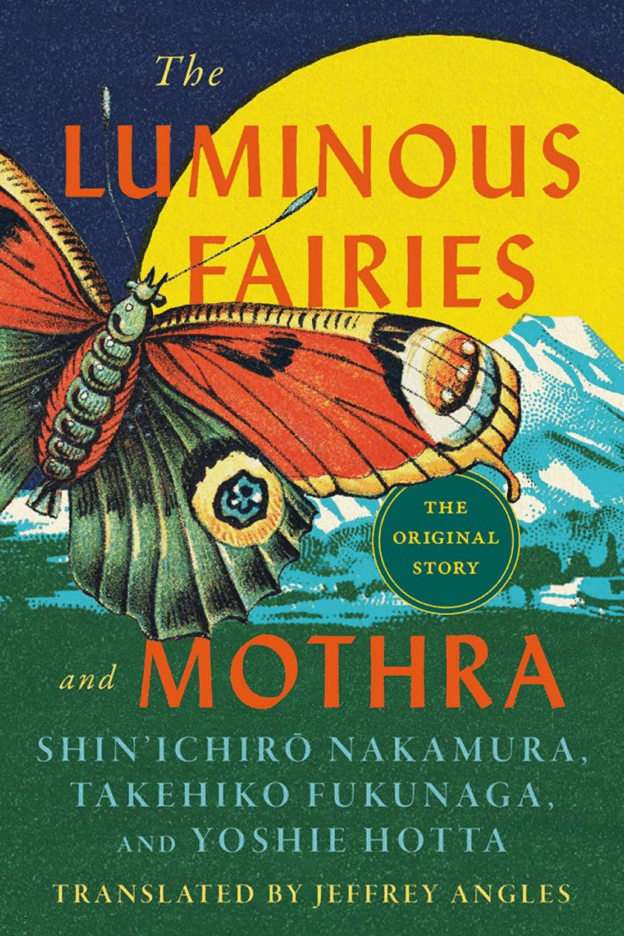
Book Review: The Luminous Fairies and Mothra written by Shin’ichro Nakamura, Takehiko Fukunaga & Yoshie Hotta, translated by Jeffrey Angles.
The remote Infant Island, somewhere in the Pacific Ocean, was believed to be uninhabited. Thus the nuclear superpower Rosilica has been using it to conduct their atomic bomb tests. Now, word has come in that there are in fact indigenous people on the island who have survived the bombing. A joint Japanese-Rosilican expedition is formed to investigate. Among the team is linguist Shin’ichi Chuujou, who looks forward to learning the native language. The expedition leader is Mr. Nelson, whose scientific specialty is unclear, but who is clearly used to giving orders.
Once on the island, Chuujou quickly becomes separated from the others and almost immediately gets captured by a vampire vine. Fortunately, he’s able to set off a distress siren, which attracts a tiny woman who frees him. At first, the other expedition members don’t believe this wild story, but soon it becomes clear that the shoubijin,
“tiny beauty” really does exist. Mr. Nelson seems very interested in this, but not in a scientific way.
When the expedition returns to Japan, Mr. Nelson clamps down on all discussion of what they’ve found, bringing political pressure to bear. Reporter Zen’ichirou Fukuda is naturally dissatisfied with the news blackout, and manages to make friends with Chuujou, who can’t break the silence, but does encourage Fukuda to go see for himself.
Fukuda, armed with basic vocabulary by the linguist, manages to get to Infant Island and meet the locals, a tribe that primarily lives underground, explaining their survival of the tests. They tell him their creation myth, and that the four tiny women are called Airena, handmaidens of the cosmic egg Mothra.
Mr. Nelson also returns to the island, but this time he’s brought gunmen. They kill several of the unarmed natives and capture the four Airena. Fukuda, also unarmed, is unable to stop them.
Back in Tokyo, Mr. Nelson reveals the existence of what he calls “fairies.” He plans to exhibit them to the public for high prices, and develops an entire stage show based around them. The Airena disconsolately sing at every show, calling again and again, “Mothra…Mothra…” Mr. Nelson pooh-poohs criticism. Everyone knows fairies aren’t humans, and therefore have no human rights.
And on Infant Island, the egg begins to hatch. Mothra has heard the pleas of its people! Mothra is coming!
This is the novella the classic monster movie Mothra (1961) was based on. It was created at the behest of Toho, with the three authors each taking a section.
The story itself is short, and skeletal in places. The authors were aware that this would be turned into a movie, so left plenty of space for specific special effects and choreography. Just from the summary above, fans of the movie will be able to notice several changes made to the film. Reducing the number of “fairies” from four to two and having an actual song written for them was an especially good change based on the casting.
Rosilica is a pretty clear stand in for the superpowers of the late 1950s and early 1960s, mostly America, but with a bit of the Soviet Union included. There’s a heavy political undertone in the novella, softened somewhat for the movie.
There’s as much space dedicated to the translator notes. Professor Angles discusses how the novella came to be (including a quick recap of the history of Godzilla and Godzilla Raids Again for those of you who missed that book), the biographies of the authors up to that point, the history and culture of the time that influenced the story,
Of special interest is a section on how the Doctor Dolittle series by High Lofting, especially Doctor Dolittle in the Moon (1928) might have influenced this story. I had not read that book, so was unaware of the similarities.
As a standalone novella, this isn’t much, but as the source for a classic movie, it’s of great interest to kaiju and monster movie fans. Thanks to University of Minnesota Press!
Mosura Ya, Mosura!”
