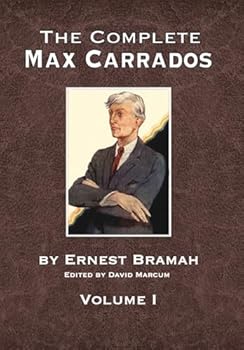
Book Review: The Complete Max Carrados Volume 1 by Ernest Bramah
Disclaimer: I contributed to the Kickstarter for this collection.
Ernest Bramah Smith, who dropped his last name for his literary efforts, was born in 1868, and was a school dropout and farmer before becoming a writer. His first published book in 1900 was The Wallet of Kai Lung, a collection of short stories about a Chinese storyteller, and he found a niche in pulpish stories for popular magazines. His first story about blind detective Max Carrados appeared in 1913, and many more stories followed, with the last being a full novel in 1934.
While popular during his lifetime, after Ernest Bramah died in 1942, most of his work fell out of print. There have been a few media adaptations of individual Carrados stories, but only now was there an effort to collect every tale of the blind detective together, in two volumes. Let’s look at the first volume, collecting Max Carrados, The Eyes of Max Carrados, and the one relevant story from the otherwise unrelated collection The Specimen Case.
“The Coin of Dionysius” is the beginning story which introduces our main characters. We first follow private inquiry agent Louis Carlyle as he attempts to find out if the coin in question is genuine or a forgery. The one coin dealer open at eight P.M. declares himself unqualified to give an expert opinion, but there is a man who is possibly the most qualified in London, Wynn Carrados. And luckily for Mr. Carlyle, he’s able to discover that the man doesn’t live that far away.
Mr. Carrados in fact lives in the borough of Richmond, at that time a wealthy suburb of London. He is at home, but shortly after Mr. Carlyle is introduced, the inquiry agent is shocked to be addressed by his birth name, Calling. Louis is further startled to learn that Wynn Carrados is his old friend from school, Max Wynn. Mr. Carlyle had been an attorney until he was disbarred for a scandal involving some stolen securities. He didn’t take them, but he also couldn’t account for them, so changed his name and occupation.
Mr. Carrados took that name as a condition of inheriting considerable wealth from an American relative who obtained that money under shady circumstances. (Later stories just have him using his original first name.) At some point in the past, he was hit in the eyes with a branch while riding, and the damage was permanent. Being a man of remarkable will, he trained his remaining senses to nearly superhuman levels.
To make up the remaining sense, his manservant Parkinson is a sharp visual observer with a steel trap memory for what he’s seen.
But to get to the purpose of Louis’ visit, Max is able to detect that the coin is a forgery by tasting it, and lays out vital details about the criminals behind the substitution. This last turns out not to be quite as miraculous as it seems, as he’d previously been targeted by the same crooks.
“The Bunch of Violets” is the last story in this volume, and takes place during the Great War, when Max served his country behind the scenes by aiding military intelligence. He’s assigned to babysit an American intelligence officer who will be carrying important papers. Mr. Hulse has, as it happens, found himself keeping company with a lovely young lady named Violet.
She is, of course, a honey trap set for an ingenious substitution plan. Max may be blind, but he’s dangerous. This story involves a Japanese character who isn’t the worst stereotype I’ve seen but does something super stereotypical offscreen at the end.
I should probably mention that there’s a certain amount of period racism and ethnic prejudice on display, though Max himself is usually not the one doing it. The collection has been edited for a few completely unacceptable slurs.
The author introduction to “The Eyes of Max Carrados” section goes into detail about where he’s lifting most of Max’s special abilities from–one blind person could do this, another can do that, Max can do it all. Helen Keller is namechecked.
Some other notable stories include:
“The Knight’s Cross Signal Problem” which concerns a train crash which caused multiple deaths. The engineer swears he had a green light, the signalman swears the light was red. Is this a tragic accident, the result of unforgivable carelessness, or mass murder? I didn’t like the ending of this story for reasons I will have to express in a spoiler section below.
“The Last Exploit of Harry the Actor” has Max and Louis visiting a safe deposit sanctuary considered the most impregnable in England. After a few minutes there, Max suggests his friend take anything valuable out of there. He’s stumbled upon the plan of the title character, a master of disguise, to bypass all the security precautions and loot the place clean.
“The Game Played in the Dark” is a suspenseful tale wherein Max is lured into the hands of a dangerous gang. His only chance is to even the odds a bit by turning out the lights. This one’s been adapted a couple of times as it’s more action packed than the usual.
“The Disappearance of Marie Severe” brings the blind detective to an isolated lane where a young girl has vanished. Her estranged father is the most likely suspect, except that he’s so impoverished that it would seem impossible for him to hide her. Max suspects something more sinister is afoot, but for once he might be wrong. The story is notable for being openly mocking of Christian Science and its followers.
“The Ghost of Massingham Mansions” has a modern (for the time) apartment building seemingly haunted by ghosts. Obviously, that can’t actually be the case, but can Max figure out how it’s done, and why?
“The Eastern Mystery” is about a doctor who has recently returned from India and his repeated brushes with death. Is he being stalked by a superstitious cultist, and if so, why? This one left a bit of a sour taste as it strongly suggests that the supernatural does indeed exist, but only for Christians.
Max Carrados tackles a wide variety of cases, and there’s often a touch of humor in the stories. Most of these are not “fair play” mysteries, Max often has outside knowledge he isn’t sharing until the explanation at the end.
There are bits that are very clever or outstanding. I like this speech from “The Mystery of the Poisoned Dish of Mushrooms”.
The more usual course is for the prosecution to exaggerate all that tells against the accused and to contradict everything in his favour, for the defence to advance fictitious evidence of innocence, and to lie roundly on everything that endangers his client, while on both sides witnesses are piled up to bemuse the jury into accepting the desired version. That does not always make for impartiality or for justice…”
Overall, it’s a good series of stories. The earlier ones are in the public domain and you can probably find them online, but you might want to see if your local library has this collection in stock or on loan. Especially recommended for fans of quirky detective fiction.
SPOILERS Section
“The Knight’s Cross Signal Problem” has a villain who has valid reasons to speak out against British racism and colonialism. We can kind of handwave that, as his motives for the actual crime were entirely selfish. However, his plan is to use his murder trial to speak out about the injustice to his homeland and get his cause into the papers.
Max doesn’t want a native uprising, so persuades the villain to commit suicide quietly to prevent his loved one from being touched by the scandal; the case will officially go unsolved. Which is clever, perhaps…except.
Except that the reason Max was brought into the case in the first place was to clear an innocent man who will not now be exonerated. This isn’t mentioned, and I suspect the author lost track of the plot thread in his satisfaction at this clever ending. Oops.
