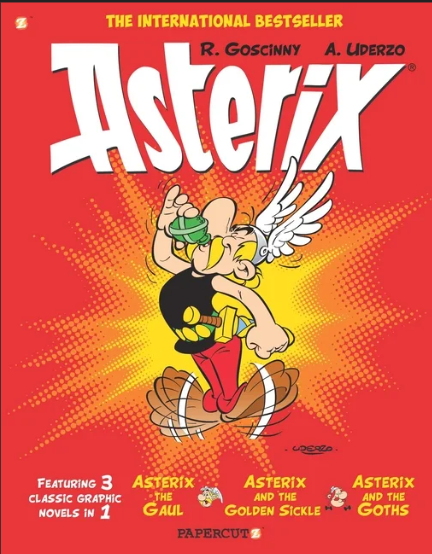
Comic Book Review: Asterix Volume One Written by Rene Goscinny and illustrated by Albert Uderzo
It is the year 50 B.C. and Gaul has been conquered by the Roman forces under Julius Caesar. Well, almost conquered. There’s one small village that refuses to surrender, and although it is surrounded by four Roman encampments, has managed to fight off all comers. How, you may ask? Well, first, their druid Panoramix brews a magic potion that grants the villagers superhuman strength.
But also, the Gauls have two great warriors, the small but cunning Asterix, and his hefty chum Obelix, who fell into a cauldron of potion as a baby and has permanent strength that also helps him in his day job of menhir delivery. And it is their adventures that concern us here.
This beloved French children’s comic book series began publication in 1959, and has outlived its creators. There have been several animated movies, a couple of live-action ones, and a TV series. This omnibus edition contains the first three albums with a newer translation.
“Asterix the Gaul” starts off by explaining the basic premise, then shifts into the main story. Roman general Crismus Bonus reasons that there must be some secret to how this one Gaulish village keeps beating his troops. He voluntolds scrawny soldier Caligula Minus to disguise himself as a Gaul and infiltrate the village. This is accomplished by having Asterix and Obelix “rescue” him from a Roman patrol.
We’re briefly introduced to pompous village chief Vitalstatistix and tone-deaf bard Cacofonix. Caligula is not happy to be among such violent and freakishly strong people. He manages to trick the villagers into revealing that the potion exists, and even get a dose (it’s noted that it makes you stronger, but not invulnerable–that’s a different potion.) Shortly thereafter, he’s exposed as a spy, but manages to escape.
The next time Panoramix goes into the forest to gather mistletoe, he’s captured by Roman soldiers lying in wait. Chrismus Bonus wants to learn the secret of the potion, as he has ambitions of making himself ruler of Rome. The druid is understandably unwilling to divulge this. Both torture (tickling) and bribery fail to move him.
Meanwhile, Asterix notices that Panoramix has been gone an awfully long time and goes to look for him. He meets an ox merchant who saw Roman soldiers carrying off a druid, and fast talks the merchant into assisting him to get into the nearest Roman encampment, Lilchum.
Asterix gets in, talks to Panoramix, and they come up with a plan to prank the Romans. Asterix allows himself to be captured, and the threat of torture against him “convinces” Panoramix to brew up some potion for the Romans. He wastes their time with multiple ingredient fetch quests, most of which aren’t actually needed. Then the potion is brewed!
The potion turns out not to be the one for strength, but one with an entirely different effect. Hilarity ensues, and in the meantime, Asterix is given a dose of the real potion. Julius Caesar arrives for a surprise inspection and is appalled by the condition of the soldiers and the reveal that Crismus Bonus was trying to overthrow him.
Caesar will let the Gauls go this time, but warns Asterix that he will surely someday conquer them. Asterix is all “have a go if you think you’re hard enough.”
Panoramix and Asterix return to the village, where there is a feast (this is the usual ending of the stories.)
Obelix is absent for most of this adventure, but will be more prominent in future.
“Asterix and the Golden Sickle” has its plot kicked off when Panoramix breaks his golden sickle. This is a problem because first, any other method of harvesting mistletoe makes it lose its magical properties. And also, the big periodic meeting of druids in the Forest of the Carnutes is coming up, and he’d be embarrassed to show up without his badge of authority.
The local smith doesn’t have the skill to create a golden sickle, so someone must go to Lutetia (modern Paris) and fetch one from the famous goldsmith Metallurgix. Asterix volunteers to go, and Obelix goes along as Metallurgix is his cousin. (He’s bringing a menhir as a gift.)
After some minor adventures, the pair makes it to Lutetia, which is a sprawling metropolis by local standards. They’re surprised to find Metallurgix’s shop/house closed and the smith mysteriously absent.
There turns out to be a criminal conspiracy to crack, and some Roman jails to get in and out of. But eventually, Metallurgix is rescued, and our heroes return home in triumph.
Some jokes about life in the big city with its crowds and pollution are sprinkled throughout.
“Asterix and the Goths” follows on almost immediately, as it’s time for Panoramix to attend the druid gathering in the Forest of the Carnutes. Asterix and Obelix volunteer to escort the druid to the edge of the forest, but they won’t be able to go in as non-druids are forbidden.
Some way to the east, Roman soldiers are guarding the border between Roman-occupied Gaul and the land of the Goths. Or they were, until a small band of Goths (the barbarian kind, not the aesthetic kind) overpower them to get into Gaul. The Goths are led by Tradjic, who has a plan.
The three Gaulish villagers are stopped by a Roman patrol, but there’s a truce on for druids. Panoramix’s old friend, fellow druid Frumthestix, shows up to help provide bonafides. Asterix and Obelix make camp outside the forest while they wait.
Tradjic’s plan is to infiltrate the forbidden forest, observe the druids at their contest, and kidnap the best one to have him use magic to help them conquer Gaul.
The druids compete with their magic potions and Panoramix wins Druid of the Year with his strength potion. The Goths decide to abduct him, naturally.
This leads to much confusion as the Goths, Romans, and Gauls cross paths and don flimsy disguises, though the Goths are able finally to get Panoramix to their own land. Chief Metric is pleased, but Tradjic has designs on his job.
Unlike most of the other peoples in the setting, the Goths speak their own language (represented by using Gothic font) so they have to use a translator named Rhetoric to communicate with their Gaulish captive. Panoramix doesn’t let on for a while that he’s fluent in Gothic.
Since all the Goths believe that they should be the leader, Asterix and Panoramix are able to use some cunning and doses of the magic potion to turn the whole area into a war of all against all and thus slip away.
Content note: There’s a scene where a man is about to be drawn and quartered–fortunately he’s had a dose of the potion. Other methods of horrific execution are mentioned.
The poor Roman soldiers suffer greatly in this one, especially the border guards. How do you define an invasion, anyway?
These are fun stories full of puns and jokes as well as mild adventure. While Asterix and Obelix sometimes carry weapons, when attacking other humans, they exclusively use their fists. No humans ever die, suffering bruises and bloody noses at worst. Death is threatened often enough, but never actually carried out. Boars are killed off-panel, but we never see them until they’re turned into roasts.
Over the course of the stories, we see that there are good and bad people of all national origins (though it takes the Goths longer to have a good person, possibly the creators were still angry about World War Two.) Fighting is all in good fun, and most reasons for war are shown to be silly.
While the creators did a lot of historical research, historical accuracy is always secondary to the jokes. There’s a lot of anachronism in the language and visuals. Still, there are some jokes that rely on the reader knowing at least a little about French history.
The art is cartoony and exaggerated, suitable for the type of story being told.
Since it’s early days, several of the recurring characters aren’t introduced in this volume, and the villagers who aren’t the main trio don’t get more than cameos.
One name note: earlier English translations had the druid’s name be Getafix, but since Panoramix works perfectly well in English, this translation keeps his French name.
This delightful series fell off a bit after Goscinny died, but up to that point it’s highly recommended for children of about eight and up, fans of comedic adventure and people wanting to try French comics.
