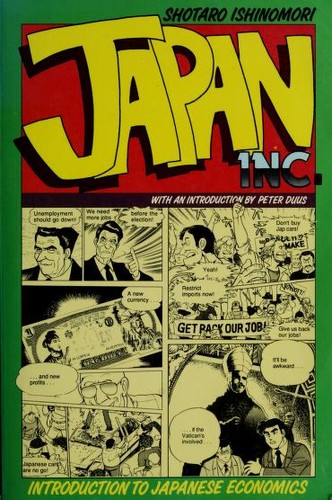
Manga Review: Japan Inc. by Shotaro Ishinomori
It is the 1980s, and Mitsumoto Trading Company is attempting to navigate the “bubble economy” that Japan is experiencing. We follow the activities of a small group of their office workers, and in particular the contrasting efforts of the amoral Tsugawa and compassionate Kudo. Which approach is better, or are they both needed to guide the company through its struggles?
This edutainment manga was written and drawn by Shotaro Ishinomori, creator of among many other things, Cyborg 009. The facts and figures are from Zeminaru Nihon Keizai Nyuumon, an economic textbook put out by a Japanese economic newspaper. The idea is that by humanizing the economic actors and telling stories about how various parts of the economy function, readers will be able to more easily absorb the information.
Since this volume was brought to the United States at a time when manga was still a very new thing for American audiences, and the primary demographic target was not comic book fans but businesspeople, the introduction gives a short history of what manga is and how it developed. At the time, Japan was riding high in the American economy, so there was a lot of focus on learning about Japanese business practices in the business literature of the time.
Also because of the target audience, the pages were flipped to read left to right, and then some individual panels reflipped for readability.
In contrast to how Japanese businessmen were portrayed in American media at the time, this manga shows the workers of Mitsumoto constantly worried about the economy and trying to keep the company’s head above water.
Kudo and Tsugawa started in the company together, and were initially close friends, but have drifted apart as Tsugawa became more determined to get ahead at any cost, while Kudo retains some of his youthful idealism. They’re contrasted in many ways. In particular, Tsugawa is financially better off than Kudo, but cheats on his wife and emotionally neglects his children, while Kudo’s family has a tighter budget but a healthier relationship. Kudo’s mentor in the company is Akiyama, an executive in the records office–he’s wise and careful, but his career has stalled out. Tsugawa’s mentor is Toda, the pair’s direct manager. He’s more devious, and his career is still on track, but his greed and carelessness have left stains on his record.
Also at Mitsumoto are Amamiya, an office lady (we call them administrative assistants these days) who admires Kudo and acts as the one woman involved in the discussions, and Ueda, a rookie salaryman from a rural area who’s still socially clumsy and continually impoverished on his starter salary.
The chapters cover various economic topics that were hot in the mid-1980s. The American automobile industry fighting against the importation of Japanese cars, while protectionism of Japanese agriculture by Japan’s government made it hard for American food products to enter that market; inflation; dealing with oil-exporting nations during regime change; the aging of Japan’s population, and Vatican bank scandals.
There are guest appearances by the then-current Japanese prime minister and U.S. President Ronald Reagan. (The latter depicted as being just a little too into old movies.) Also, Lee Iacocca of Chrysler Corporation, under a thin pseudonym. For our younger readers, Mr. Iacocca was an executive at first Ford Motors and then Chrysler, and was the public face of the American automobile industry in the 1980s.
There’s quite a bit of blocks of text, with definitions of economic terms, explanations of various government agencies, and loads of numbers (which admittedly are now very dated.)
The most affecting storyline is when Ueda’s aging mother arrives from the countryside (he’s the youngest of nine children) and bluffs that she’s ready for a nursing home. This results in the cast posing as her extended family so they can check out elder housing for investment purposes. They learn that while the fancy place they visit is shiny and nice on the surface, it’s nowhere as emotionally fulfilling as letting seniors live with their families.
The weirdest moment is when shadowy government figures meet and plan for a combined fiat currency for the United States and Japan called the “dolen.” This is played seriously in story, but is just so silly that I’m glad it did not happen in real life.
The art is serviceable to excellent depending on the page; the celebrities are identifiable and the scattered action moments are good.
Content note: A bit of violence, fatal a couple of times. On page (but very stylized) sex. Male oriented fanservice. Ethnic prejudice. Quite a bit of drinking and smoking in a social context. Tsugawa cheats on his wife, and is mildly surprised to see a woman in a relatively powerful position in her corporation. (He’s not objecting, though.) BDSM is treated as a shameful thing by society. A joke about country moms being concerned whether prospective wives have child-bearing hips. Nothing a precocious teen couldn’t handle, but the general tone is aimed at working adults.
This is now something of a curio, a snapshot of the Japanese and American economic picture of the mid-1980s. But that makes it a good collector item for manga fans and economics students. Highly recommended for those interested in the early history of manga adaptation in America.
