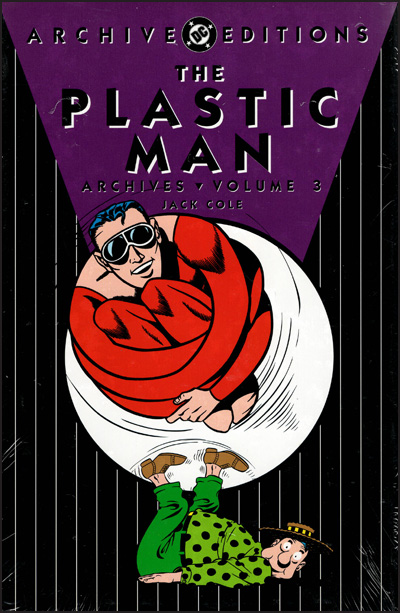
Comic Book Review: Plastic Man Archives Volume 3 by Jack Cole
Plastic Man was first published in Police Comics #1 in 1941. He wasn’t the first stretchy superhero in comics, but quickly became the most popular. Much of this was down to the talent of Jack Cole (1914-1958), who did both the writing and art on the feature. His innovative use of the character’s powers and good mix of comedy and action made an effective pull for readers.
This volume, covering Police Comics #31-39 and Plastic Man #2, opens with an introduction by Michelle Urry, the cartoon editor for Playboy, who writes about her experience when she first came to that magazine and Hugh Hefner cited Mr. Cole as a prime example of the kind of cartoonist suited for publication there. She talks about the difference between the saucy cartoons Jack Cole did for Playboy and the kind of women featured in his earlier Plastic Man work.
By 1944, when these stories were published, Plastic Man was the cover feature for Police Comics, with no other stories even being mentioned on the covers. The current status quo was him being an agent of the F.B.I., with Woozy Winks as an unofficial tagalong.
“Washed Up” starts the volume with a reminder that World War Two was still going on. Plas is investigating the Mangler, a renegade doctor who assists draft dodgers by turning them from 1-A prime military candidates to 4-F medical exceptions. Rather than supply phony medical certificates (*cough*bonespurs*cough*) which could be disproven, he and his lesser surgeons actually use their skills to physically maim the patients.
Plastic Man disguises himself as an actual draftee (he uses powder to change the color of his hair) and is taken to the office of Dr. Slicer. After he ascertains that this is in fact part of the racket, Plas starts kicking butt. However, Dr. Slicer is not in fact the head of the gang. The Mauler taunts our hero by intercom and skedaddles out the secret exit.
Woozy Winks had been set to watch for something like that, and when Plastic Man arrives, there are signs of a fight, but no Mangler or Woozy, just a note. Reading that note takes the starch out of Plas.
Licked, our hero drags himself to Chief Brannon’s office to resign, but Brannon’s not listening. He needs someone to capture Knife McBlade, the notorious dagger thrower. Plas is in no shape to stand up to the demand, but despite his complete lack of enthusiasm, manages to catch the crook accidentally. (“For the wicked flee where no man pursueth.”)
Now, Chief Brannon finally has a moment to notice something’s wrong. It turns out that the note says the Mangler has captured Woozy, and will kill him if Plastic Man dares to pursue that case. Naturally, that means Plas is washed up as a G-Man. But Brannon points out that Woozy Winks is The Man Mother Nature Protects from Harm! He can’t be killed!
That perks Plastic Man right up, though he hasn’t seen the power work recently, which is why he forgot about it. It’s worth the risk to try to track down the Mangler and rescue his sidekick.
As it happens, Woozy is in fact still protected by Mother Nature and wacky “coincidences” keep occurring to prevent the Mangler from killing him until Plastic Man arrives to catch the criminals. This is, however, the last time in this volume we’ll see this power activate.
“His Lordship Woozy Winks” is the final story in the volume. Woozy is being followed around by two distinguished looking old gentlemen, much to his paranoia. Turns out that they’d overheard him giving his name at the delicatessen, and they have been looking for just such a Winks.
They’re from the British island possession of Bladau, and Lord Jeffrey Winks, master of Valmoral Castle, is dead. He left his entire estate to his nephew–this is the first Woozy is hearing of having an uncle. But it seems to be a pretty sweet deal. He gets to be a lord, Valmoral Castle is his, and there’s an income of a million dollars a year. This last convinces Mr. Winks to accept his inheritance.
There’s a couple of catches though. First, Woozy must appear to take possession of Valmoral before the end of the week, and oh yes, most of the previous Earls, including Lord Jeffrey, have died by beheading. Uh-oh.
The butler and valet that come with Valmoral are creepy looking, to the point Woozy doubts the valet’s humanity. A visitor arrives; it’s cousin Sir William Pilson from the neighboring estate. He seems genial enough, but clearly takes a ghoulish pleasure in recounting the legend of the Knight of the Tower. Supposedly, this knight was beheaded for a crime he did not commit by the first Earl, and vowed vengeance. He allegedly has beheaded several Earls of the Winks line, including by using the guillotine that the Earl who was in place during the French Revolution foolhardily imported for the castle.
Hijinks ensue as Plastic Man tries to prevent the Knight from beheading Woozy and find out if something supernatural is really going on, or if there’s a more natural cause for the deaths. Naturally, there’s a twist at the end that means Woozy Winks isn’t actually a rich aristocrat.
In between, some highlights include a story set partially in Mexico, which also involves Plas, Woozy and four gangsters all disguising themselves as women (only shapeshifter Plastic Man “passes.”) A mind-swapping story. A town trapped in the Gay Nineties (which was a huge nostalgia thing in the 1930s-40s), a man made of lava, Woozy for once getting to win a fight honestly, and also experiencing love…or does he? That last story returns to wartime as the gangsters are stealing the allotment checks sent to soldiers’ families.
Plastic Man’s powers lend themselves to creative uses and visual gags, as well as dynamic action scenes. The continuity is…limited, so try not to expect consistency with previous stories. But the individual tales are fun.
Content note: Lots of slapsticky violence, often intended to be lethal. Some period ethnic and gender stereotypes. Maybe younger readers should have some adult guidance to explain various references and why we don’t use those stereotypes anymore.
As usual with the Archives volumes, this one is spendy, so maybe check your local library first. Recommended to fans of stretchy superheroes.
