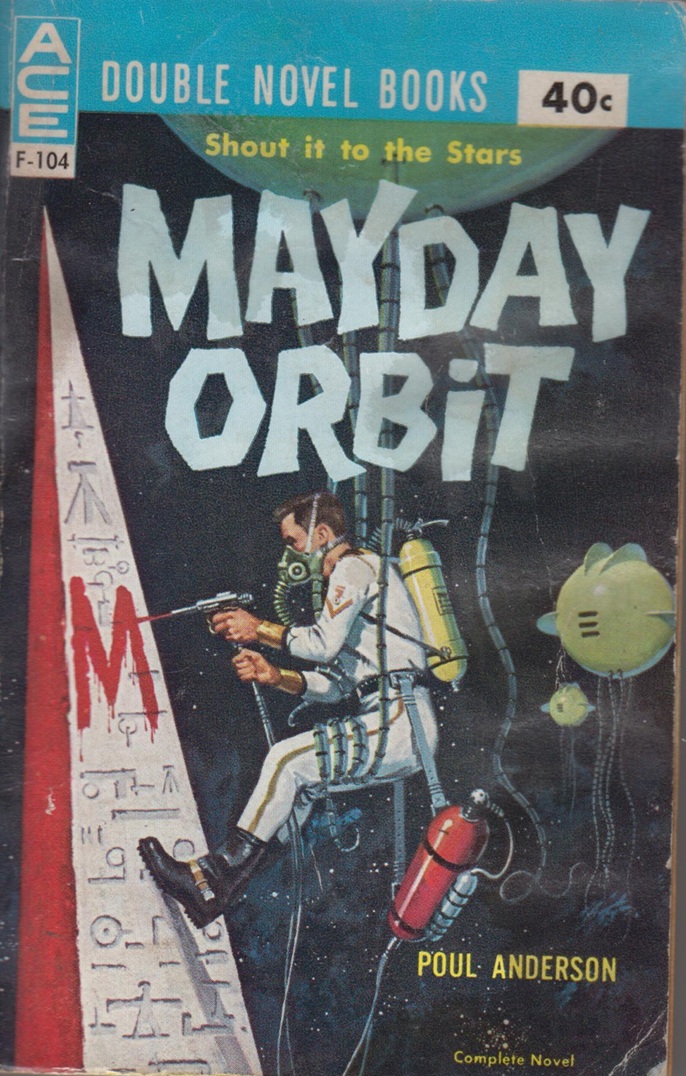
Book Review: Mayday Orbit | No Man’s World by Poul Anderson and Kenneth Bulmer, respectively.
It’s time for another science fiction Ace Double, two books in one!
It is the 31st Century, and the Terran Empire has passed its peak. Oh, to be sure it’s still very large and powerful and the vast majority of its citizens are quite comfortable. But the bureaucracy has become stultified, the overall culture is decadent, and the alien Merseian Empire is eating its way in around the edges. The Long Night is coming. Captain Sir Dominic Flandry of Imperial Intelligence knows this, but his job is making sure the Long Night doesn’t fall while he’s still alive.
Flandry’s current mission is to the independent planet Altai. It was settled during the first wave of expansion out from Terra, by a mixture of people with Central Asian roots. A cold, resource-poor planet, Altai’s civilization lost the top level of its technology and interstellar communication, taking on many traits of the nomadic peoples they were descended from. The dominant religion is a blend of Buddhism and Islam with the sacred text carved into an enormous monolith in the current capital city.
When contact was reestablished with the outside universe, it was with the aliens of Betelgeuse, who were closer than any Imperial world and were willing to trade for local goods. The Betelgeusians then let the larger human part of the galaxy know about Altai. There was no rush to integrate Altai…then. But a century or so of shifting political borders now puts Altai near the Merseian imperial zone of influence, and intelligence suggests the aggressive aliens may have their eyes on the remote world as a military outpost.
Flandry has been sent as an advance agent to see if there’s any truth to this. As it turns out, there is. The Merseians have been secretly working with the Khan of the capital city, offering him advanced weaponry so he can finally wipe out the dissenting tribes and consolidate himself as dictator of the entire planet. In exchange for which he’ll agree to let them build military bases.
The Khan didn’t have proper operational security in place because no one from the Terran Empire had been by in years so their agent showing up wasn’t taken into consideration. Now that Flandry’s here and has seen the military buildup, he can’t be allowed to report back. On the other hand, they don’t have proof that he’s a spy and aren’t sure whether they should kill him yet, so he’s made an involuntary guest.
That night, a serving girl named Bourtai turns out to be from one of the dissenting tribes, an orphan due to the Khan’s conquests. It takes her some effort to convince Flandry that she is not a trick to make him confess, but once convinced, they help each other escape.
Can Flandry convince the dissenting tribes to help him, and how is he going to get a message off-planet?
The Dominic Flandry books, part of the “Technic History” cycle, draw upon both the decline of the Roman Empire and the then-current Cold War. Dominic is an urbane, classy government agent in much the same style as James Bond, but the latter had not in 1961 acquired so much of a stranglehold on the popular culture of the spy drama, so it’s more a matter of them coming from similar literary roots.
Flandry largely means well in the “greater good” sense. The Terran Empire has many flaws, but the alternatives are presumably worse. He has to exercise a certain ruthlessness towards the people he’s using to achieve his goals, but generally works to minimize the damage to them. If he is a bit loose with women, he also respects their autonomy and isn’t going to force anything. On the other hand, Flandry deliberately violates two major Altai cultural taboos in big ways, which would normally result in him being executed.
The ending does rely on the Terran Empire having retained certain American cultural knowledge into the far future that the Altai people are unfamiliar with, which flatters the intended audience.
This is a short, fast-paced book, and we don’t dive deeply into Dominic’s character or the Altai culture and setting. Recommended for secret agent fans.
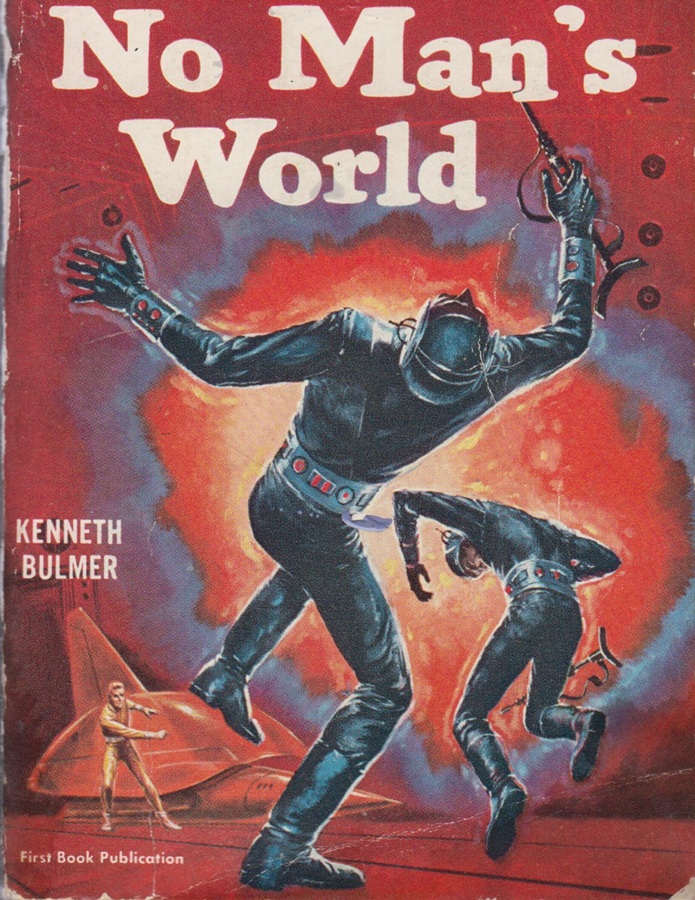
David Caradine used to be an important person with a government job, but that was a while back. Nowadays he chooses to go by the name John Carter because it gives him a chuckle, and works as a trade facilitator (basically a salesman) for his new home star cluster of Shanstar.
We are far into the future, and as far as anyone knows, the Earth is a myth, a cautionary tale told to children about the hubris of humanity back when it still had different races, religions and languages. Sadly, the removal of those diversities has done nothing to rid humanity of bigotry and bullying. Nowadays, the point of pride is how many planets are in your polity. The more worlds your coalition controls, the better you are.
People from Ahansic, with more than sixty worlds, are justified in treating people from Shanstar, which barely has fifty planets, like the inferiors they are. But they’re both insects to the people of Horakah, with its more than thousand worlds. And it is to the entry world of Horakah-Gamma that John Carter has come.
He’s hoping to open trade with the larger polity using a really fine brand of cigars(!) but has other goods in mind if that fails. But first he must secure a passport to the capital world of Horakah-Alpha. The passport official seems friendlier than expected; however, John’s rival business travelers may not be what they seem or claim.
Once he’s on Horakah-Alpha, John Carter finds himself reverting to his David Caradine days as his life is constantly in jeopardy. What’s really going on with that military buildup, and is there anyone he can trust?
This story’s a bit harder to predict than its counterpart; it goes very different places than the opening would have led me to believe. The big “twist” is well-telegraphed, but what it actually means to the story is not clear for quite a while.
John Carter (who I chose to imagine being played by actor David Carradine) is somewhat nebulous as to age. His background suggests a man closer to senior citizen than not, but once he is threatened, he acts more like a young action hero. He’s also not averse to a little extramarital sex, though he likes his women mature. (And in his defense, she deliberately didn’t tell him she was married.)
I felt a bit let down by the ending, which makes this a shaggy dog story from the perspective of everyone but John Carter and Carson Napier. All that–for this?
Less recommended, but worth a look as long as you’ve already got the book in your hands.
