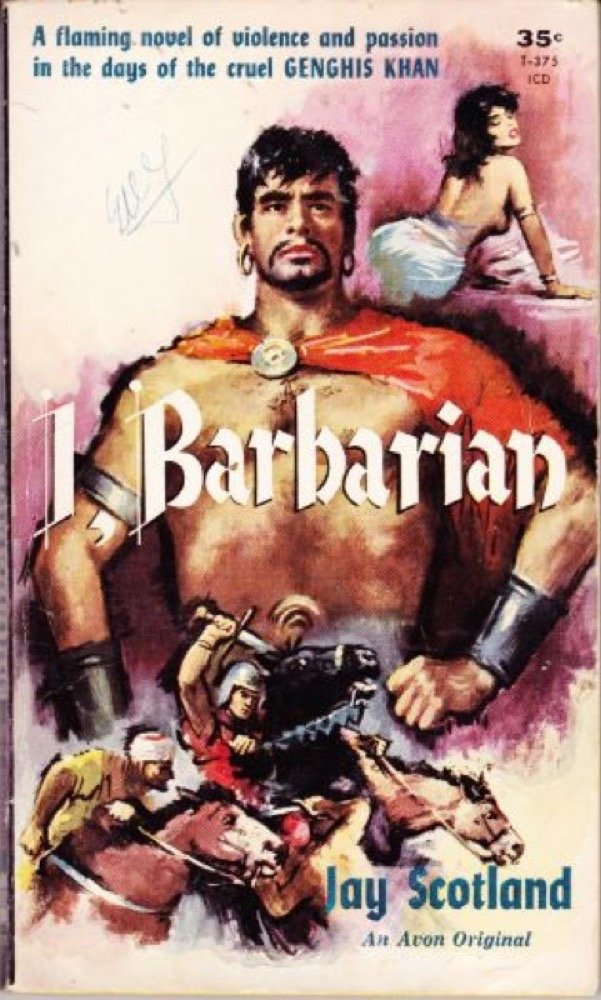
Book Review: I, Barbarian by Jay Scotland (John Jakes)
James the Frank is not called that because of his honesty, though he does have a tendency to tell the truth even when it’s not convenient. He’s called that because his Crusader father got very lost and wound up at a yam station (kind of an outpost on the Mongolian version of the Pony Express). James’ mother, not a person from Frankinstan, but probably European, had already died, and James’ father passed away from his accumulated wounds and exhaustion a few months after arriving. The child was adopted by Kojin, keeper of the yam station.
Kojin was childless, so he also adopted a developmentally disabled boy named Tadda, and raised the two boys with all the love their culture allows. While James is culturally Mongolian, he’s well aware that he’s an outsider, and his ultimate destiny must lie elsewhere than this remote outpost.
“In the Christian year 1217” the first arrow of that destiny arrives in the form of a caravan hauling captives from recently conquered Cathay to Karakorum, seat of the mighty Ghenghis Khan. The expedition is led by particularly cruel tar-khan Hargoutai the Falcon. He has set his sights on the most beautiful of the new slaves, the high-born Cho Soo. Hargoutai is even considering just claiming herself for himself rather than waiting to be awarded her by the kha-khan, something allowed by his high rank.
An unusually strong storm forces the caravan to seek shelter at the yam station for two nights. Hargoutai is one of those guests who stretch the bounds of hospitality, rude to Kojin, bullying toward Tadda, and outright racist towards James. He puts Cho Soo on display before the men, obviously enjoying her shame and discomfort. He is, however, a heavy drinker even by Mongolian standards, and on the second night Cho Soo and James are able to meet for a conversation.
The two young people quickly bond and fall in love. They’ve just advanced to heavy petting when Hargoutai awakes and finds them. He decides this is “adultery” even though he had not officially claimed Cho Soo yet, and sentences James to death by slow mutilation. He also kills Kojin when that man objects, and whips Tadda for also interfering. James is down to nine fingers when Cho Soo breaks and promises absolute obedience to Hargoutai for the rest of his life in return for sparing James further punishment.
The caravan departs, and James and Tadda must carry on running the yam station the best they can without their father. Tadda never recovers from the ordeal, and dies in a riding accident a few months later. James carries on until a dispatch rider arrives badly wounded by a bear. He suggests that he take the rider’s place and deliver the vital messages to Karakorum. The rider reluctantly agrees when he realizes his wounds really are too bad to travel. And so James leaves behind the only home he ever knew.
This historical fiction novel was apparently the first published work by John Jakes, who wrote it under a pseudonym. When his career took off later, it was republished under his primary name. First thing I need to make clear is that this is very much a 1950s American take on Genghis Khan and Mongolian culture. While the presentation cares enough to indicate that there are better and worse Mongols and their culture is normative, James is often sickened by the same sort of thing 1950s Americans would be.
James delivers the dispatches and is immediately embroiled in family politics. Genghis is intrigued by this blond man with nine fingers (a mystic number to the Mongols) who has asked to join his army, but his eldest son Juichi the Guest mocks James as probably being a wimp who could never survive the harsh life of a Mongol warrior. Youngest son Tuli, Master of War, appears more clever and moderate, but unfortunately is the patron of Hargoutai the Falcon.
James and Hargoutai present their cases, and it’s judged by the great Khan that they are both telling the truth as they see it. James’ punishment for “adultery” is considered completed, but to get the young man away from the temptation to see Cho Soo again, he is assigned to the Mangudai, the shock troops that are first into any great battle. Not one in a hundred survives.
Except that James takes especially well to the training and makes friends with the powerful if not exceptionally bright Bela, who becomes his brother in arms. When the Mongol horde invades the Muslim lands of Samarkand, the two acquit themselves well, James saves Juichi’s life, and they are promoted to gur-khan (petty officer, basically). But there is still a long hard road and much suffering to endure before James can again confront Hargoutai and reclaim his true love.
This is the stuff of epics, with great battles, hard-won fights, and steamy love scenes. John Jakes was good at this stuff, even this early in his career. That said, obscenity laws were still in full force so some things need to be suggested rather than said.
James is an interesting protagonist who we can mostly root for as he tries to navigate the harsh realities of his culture and his finer feelings. Hargoutai, by comparison, is a hissable villain who may be good at combat but mostly abuses his high rank to get away with his foul actions.
Genghis is a cruel man, but by his own lights a fair one. For all that he is supreme ruler, he feels bound by the Yassa, the law code of his people, and must navigate it wisely.
Cho Soo, alas, is a damsel in distress who’s off-page for the majority of the story, waiting for her blond savior.
Content note: Lots of lethal violence, death of civilians, women and children. The Mongols, including James when he cannot get out of the duty, commit war crimes. Torture. Rape is mentioned, and Cho Soo is subjected to marital rape off-page. James indulges in consensual extramarital sex, though that’s clouded by the women’s circumstances. Slavery. A bit of period ethnic prejudice. Alcohol abuse. Horses are killed on the regular, but never in detail. Older teens should be okay, but might also want to consult more modern sources, including Mongolian ones, to learn about Mongol culture as it actually existed.
I don’t think this one has been reprinted recently, so you may need to check in the better used bookstores. Recommended to fans of older historical fiction.
