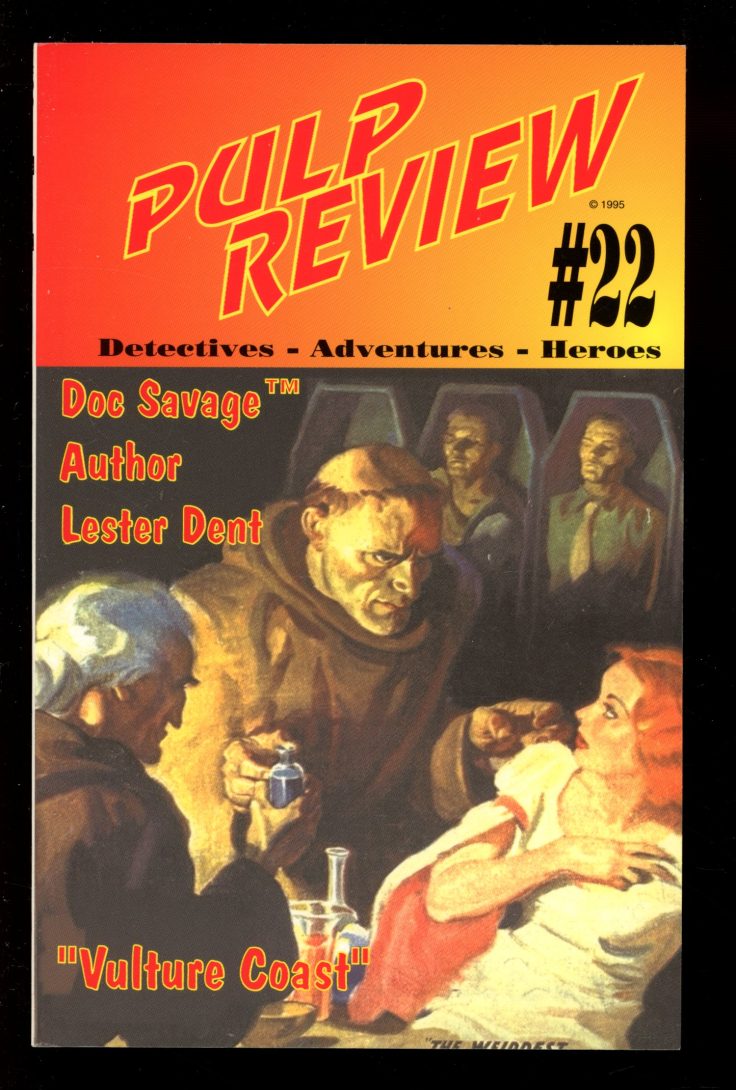
Magazine Review: Pulp Review #22: Vulture Coast edited by John P. Gunnison
As I mentioned in my review of High Adventure #200, that pulp reprint magazine was known as Pulp Review for its first 23 issues, and I have some of those earlier issues, that I hope to get to before I die. Let’s look at #22, which was already winding down the old format.
“Vulture Coast” by Lester Dent is an air adventure story. Irish-American test pilot Power O’Malley is flying a new model of amphibious aeroplane off the coast of California in 1930 when he spots a tiny fishing boat that appears to have drifted out to sea. It’s a trap. The three men aboard turn out not to be suffering at all and ambush him. He kills one mostly by accident and has a decent chance to beat the others when a submarine surfaces nearby with a large contingent of armed men.
Captured, Power is taken aboard the sub and introduced to its master, Captain Teek. This man is an “albino Negro” and the leader of a band of South Seas pirates who managed to steal a Japanese submarine and relocated to California waters where no one would be expecting them. The “lost fishing boat” ruse was one of two plans to get hold of an airplane which the gang will need for their operations.
Unfortunately for Captain Teek, the man Power killed was the only available pilot in his crew. So he needs to keep the pilot alive to fly the plane until the other pilot returns from the other plan. Thus Power is rowed back to his plane with a couple of thugs to make sure he won’t try to fly the aeroplane anywhere they don’t want him to. Making it especially uncomfortable for Power, one of the men keeping an eye on him is Pogi, the brother of the man he killed. (Pogi is repeatedly described as “Japanese” but his name is Tagalog for “handsome” so presumably a nickname bestowed by his fellow pirates.)
Once at the hidden base camp in Baja California, Power attempts to escape with the pretty female hostage the pirates had captured earlier. This fails, and Pogi decides, now that the other pilot has returned, that Power will assist their next act of piracy by being tied to a torpedo. How is our hero going to get out of this one?
Content note: There’s a lot of racist language choices in the narration. Lester Dent (of Doc Savage fame) knew better, so I am presuming he was writing for a specific audience. There’s also language about how freakish Captain Teek looks. Pogi implies that he’s going to rape the female hostage before killing her.
Perhaps the most innovative twist of the story is that neither Power nor the hostage have any interest in a mandatory romantic subplot as they already have love interests.
The other stories in this issue are “weird menace”, the horror subgenre where it seems like something supernatural going on, but there turns out to be a “reasonable” explanation, often involving marihuana or hypnotism.
“Satan’s Forge” by G.T. Fleming-Roberts concerns Pat Norman, who is in love with Joyce Richmond, the niece of a wealthy steel mill owner. Nathan Meed is a hard man who doesn’t much like Pat, but young Norman wants to at least check in with the man before marrying Joyce. Meed is locked inside the pouring room with an assistant that most of the other workers distrust because of his surly attitude and criminal record.
There’s a scream from inside; by the time the door is unlocked, the assistant is no longer there, apparently the victim of a pouring accident. But the cooling puddle of steel looks a lot like an outstretched hand.
Some time later, Pat receives a letter from Joyce breaking off the engagement, citing a strange illness in the Meed family, and warning him to stay away. Naturally, Pat finds a way to get inside the Meed mansion, only to find that somehow the members of the family are slowly dying of an “invisible flame” that they can feel burning them as their flesh shrivels and blackens. Nathan Meed believes it is his punishment for murdering his assistant.
Not one reader in a thousand could guess the “rational” explanation for the curse of the invisible flame. And I’m not going to spoil it for you.
“The Time Dissolver” by Hugh Speer has Ned and Holly Speer, a recently-married couple, visiting her rather elderly parents. Ned has long suspected that the older couple was unhappy with the marriage, but their behavior suggests that they are, in fact, very glad to see the young couple. The in-laws have arranged a dinner party with two other couples, who seem uncannily familiar.
The framing sequence is set in the 1980s, with Ned in a sanitarium after the disastrous outcome of the party. But the situation is ambiguous. Was the Tibetan powder really able to cause two versions of the same person at different ages to exist at the same time? Or was Ned’s sanity shattered by witnessing an unspeakable act of incest while on a hallucinogen? The world will never know.
“The Grave Gives Up” by Jack D’Arcy is a more standard weird menace yarn. Gordon Lane, a recent widower, receives a call from his dead wife begging him to rescue her before the call is suddenly disconnected. The operator confirms that the call came from the cemetary.
Despite warnings from his atheist friend Dr. Ramos, Gordon decides the call was real and heads over to the old Spanish burial ground. There he discovers the dead rising from their crypts to labor under a cruel master.
The explanation involves both marihuana and hypnotism, and a motive that might be a little more sympathetic if the villain weren’t such a horrible person.
“Murder Is a Merry Maid” by Wayne Rogers fills out the issue. The seaside resort town of Eastchester has seen three disappearances this summer, all of attractive young women who happen to be world class competitive swimmers. The presumption is that they were swept out to sea and drowned. Young movie producer Steve is at the beach with his beautiful world class swimmer wife Laura when one of the missing women washes up dead. Curiously, she’s got gills!
After the corpse is taken away, the young couple try to relax, and the local sand sculptor, Scarelli, uses Laura as a model for his latest creation. This arouses the wrath of Toby, the old balloon man, who has become suspicious of Scarelli. All three of the missing women had sand sculptures made of them by Scarelli shortly before they disappeared. Toby thinks this is some kind of curse that makes them “Brides of the Sea.”
Steve’s suspicions, meanwhile, fall on Morgan Seeley, a brilliant marine biologist who lives in Eastchester and had been working on experiments to turn air breathing animals into water breathers until a restraining order was issued against him. Morgan is kind of weird-looking and has an off-putting manner, but is the uncle of Jim Seeley, Steve’s business partner in the movie studio and the owner of the cottage Steve and Laura are vacationing in.
Toby is swept out to sea after finding a sand sculpture of himself. The autopsy of the washed up swimmer finds no gills, just wounds that are written off as being eaten by sea creatures. Steve has to head back to the city for work, and he meets another attractive world-class swimmer getting off the train at the station, who Laura is glad to see.
The new swimmer disappears, and Laura is acting strangely after Scarelli makes another sculpture of her. Can Steve save her from becoming a bride of the sea?
While hypnotism is involved, it’s the least of the shocking reveals of what turns out to be a ludicrously convoluted villain plan. And the story does that thing where a character mentioned in passing in the first couple of pages is actually super important to the climax.
I liked “Satan’s Forge” best, though “Merry Maid” is also quite amusing. The racism really hurt “Vulture Coast”. This issue is out of print, so may be hard to acquire; some of the stories may be available elsewhere. Recommended to pulp fans.
