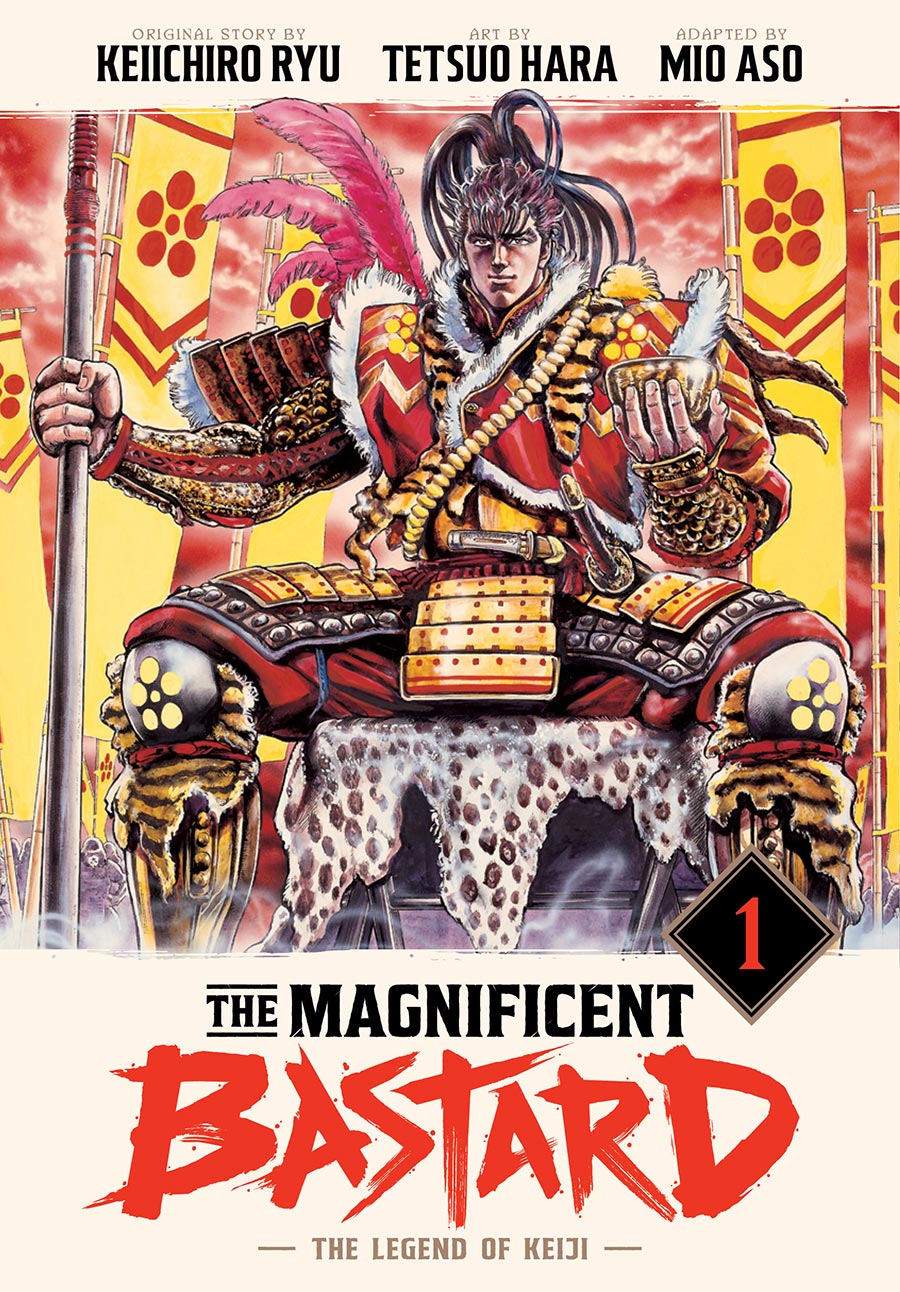
Manga Review: The Magnificent Bastard: The Legend of Keiji 1 Created by Keiichiro Ryu, written by Mio Aso, art by Tetsuo Hara
The Sengoku (Warring States) period of Japanese history is drawing to an end. In what will in modern times be called Gunma Prefecture, there lives a man named Maeda Keiji. The adopted son of Maeda Toshihisa, Keiji is an enormous man, standing a good 6’6″ in his stocking feet, and is well-proportioned for his side. To the distress of his adoptive uncle Maeda Toshiie, Keiji is a boisterous kabukimono, a free-spirited samurai who dresses in garish fashion, parties hearty, and has little respect for authority. For all that, though, Keiji is the mightiest and cleverest warrior of the Maeda clan.
This manga was based on a novel, Ichi-Mu-An Fūryūki, by Keiichiro Ryu, itself based on the life of historical person Maeda Toshimaru. It ran from 1990-93 in Weekly Shounen Jump. Sadly, Keiichiro Ryu passed away in 1989, but did approve the project and was involved in the initial planning. The Japanese title was Hana no Keiji: Kumo no Kanata ni, which roughly translates to “Keiji of the Flower: Beyond the Clouds.” Those of you who read the short-lived Raijin Comics line when it came out may remember it under the simple title Keiji.
We open in 1582, where troops under Takigawa Kazumasu (Keiji’s birth father) are attempting to round up mustangs to train and replenish their stock of warhorses, depleted by battles against the Hojo clan. Their efforts are frustrated by an enormous black stallion nicknamed “The Devil Horse” by frightened retainers. All efforts to kill or capture it have failed, and it protects the herd.
Kazuma discusses the matter with another lord, but is interrupted by noise from the courtyard. Turns out Keiji has arranged a “horse race” between the two lords’ dogs, using cats as “jockeys.” Keiji pretends not to hear their remonstrations. Summoned before Kazuma, he’s ordered to kill the Devil Horse, but refuses. He thinks it will be more fun to ride it!
Keiji is guided into the wilderness by an odd-looking peasant. This is actually the ninja spy Honeh (“bone”) who is under orders from Furuya “Horseshoe” Shichirobei of the Hojo Clan. Honeh explains, without initially revealing his connection, that Shichirobei had attempted to capture the Devil Horse, and it had nearly killed him, leaving the samurai with the oddly-shaped scar that gave him that derogatory nickname.
Keiji wins over the Devil Horse with surprising gentleness and love, and renames it Matsukaze (“wind through the pines”). They become a fearsome fighting team.
The climax of the chapter is a battle to the death between Keiji and the now infuriated Shichirobei. The issue is never in doubt, but Keiji salutes the courage of the Hojo warriors.
The second chapter shows us that not all kabukimono are good people by introducing us to a couple of them that are bullies. But this is just to set up the real villain of the week, Gankibo the Ear-Slicer. He’s a jerk who goes around forcing confrontations so he can kill people and take a grisly trophy. Gankibo forces the orphan girl Ofu to actually do the slicing and tote around his bucket of ears.
Gankibo is hired by Yotsue Shume, leader of the Kaga ninja clan, and subordinate of Maeda Toshiie. It seems that Toshiie wants Matsukaze for himself, but Keiji refuses to give up the horse, pointing out quite reasonably that it won’t accept another rider. But if Keiji is dead, he can’t refuse any more.
Honeh is now hanging out with Keiji but very specifically has not sworn loyalty to him, something that amuses Keiji because the ninja’s treachery keeps him on his toes.
The rest of the chapter is Gankibo and Shume trying to set up a duel with Keiji and his clever ways of getting out of it until his hand is forced by Gankibo killing one of the bully kabukimono who’d begun to realize the real meaning of freedom. Gankibo is dead, Ofu has a kinder master in Keiji, and Shume gets kicked in the face by Matsukaze.
Shume has lost most of his teeth, and now has a red scar around his mouth that looks like a huge painted grin. (In black and white, he looks a bit like the Joker.)
Toshiie has been told by Hideyoshi that the warlord wants to meet Keiji, but knows that his boisterous nephew will surely infuriate his superior. So he sets the young man a seemingly innocuous task, guarding a set of armor that had been presented to the Maeda clan by Oda Nobunaga himself. If it gets damaged, then Toshiie can require Keiji to commit seppuku. And Shume will make sure it gets damaged.
Keiji can accept this risk for himself, but another samurai volunteers to assist him. It’s the aged and somewhat past it Murai Jakusui. Now Keiji must not only protect the armor and himself, but this honorable but befuddled elder.
Shume ends up minus a forearm, and Keiji uses a clever trick so that no one loses face…officially, at least.
Shume gets a weapon prosthetic. (It’s not going to make him more effective.)
We learn another reason Toshiie isn’t happy with Keiji. His much younger (younger than Keiji!) wife Matsu clearly has feelings for his virile, manly nephew and vice versa. It’s one of those courtly love things where nothing illegal or immoral is going on, and Matsu is very attentive and loving towards her husband, but Toshiie isn’t cool with it.
Toshiie is brought news that his ally at Suemori castle is being attacked and the castle is about to fall. The usual customs of alliance would say that he needs to take his troops there to relieve the castle, but he’s been told not to take the bait because the enemy troops outnumber his own. He needs to hold position while the rest of the alliance gathers and strike only when victory is certain, even if that means sacrificing Suemori Castle and its defenders.
As it happens, the commander of Suemori is Keiji’s childhood friend Okumura Suke’emon, who also had a thing for Matsu, and is also a super badass.
Keiji and Jakasui manage to get a small troop out the door as a token force to reinforce the beseiged castle. Also along is Josui, Jakasui’s cowardly son, who is not thrilled about his first battle being an almost certain one-sided massacre–of him. (He gets better.)
Thanks to Keiji’s cunning, unorthodox tactics and sheer awesome combat ability, the outnumbered castle forces manage to hold out until Toshiie, who’d been shamed into action by Matsu, arrives to pretend his forces won the victory.
Then Shume comes up with another plan, farming out Keiji’s assassination to Hotaru the Spirit Drainer, a kunoichi that has a personal grudge against Keiji because he killed her first love. She sets up a fake harassment scenario that Keiji rescues her from, but can she resist his manliness long enough to actually kill him?
The English language title is using “bastard” purely in the pejorative sense, since Keiji is not born outside wedlock. The idea is that while Keiji’s behavior violates social norms and irritates stuffy old authority figures, he actually upholds the true virtues of his culture and his awesomeness makes up for any inconvenience he causes to others.
This was Tetsuo Hara’s follow-up to Fist of the North Star, and you can see a lot of that series’ visual quirks in this one. But while Fist struck a generally serious tone leavened with humor, this one is more humorous with some heavy action. Keiji doesn’t take his trauma seriously, and his philosophy hides its steel under a frivolous exterior.
Content note: A lot of gory violence, often lethal. Ritual suicide. Attempted rape, extramarital sex (genitals are blurred, but it’s made clear that Keiji is large down there even for his size), male and female nudity. Cruelty to animals. Potty humor. The primary audience in Japan was schoolboys, but in modern America maybe older teens?
The most interesting aspect of this series for the current day is being able to compare it to the more recent The Elusive Samurai, which is also about an obscure historical figure who’s unorthodox in his lifestyle and combat techniques, but shows how what’s acceptable to show in Shounen Jump has changed.
Recommended to fans of samurai action and/or Tetsuo Hara’s artstyle.
