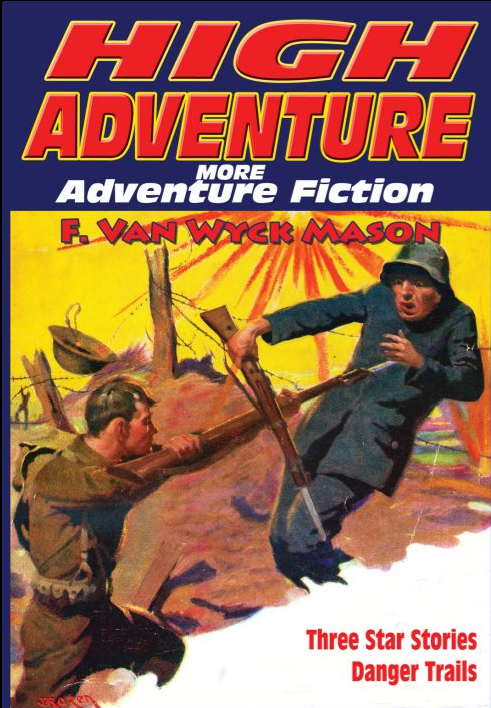
Magazine Review: High Adventure #164: War Fiction – F. Van Wyck Mason edited by James Gunnison
Filling in a back issue here, this one is World War One stories, mostly by the fellow mentioned in the title. Francis Van Wyck Mason (1901-1978), the introduction tells us, was a veteran of the French Army and then an importer who had his first story published in 1927. During World War Two, he became General Eisenhower’s Chief Historian. During his later years, he moved on from pulps to become a mainstream writer.
There’s an additional story by a different writer for page count, we’ll get to that.
“The Fetish of Sargeant M’Gourra” is that first published story. The German Fifth Brandenburgers have challenged the French Tirailleurs Senegalais to a bayonet duel, a case of schnapps wagered against a case of champagne. It may sound sporting, but the German champion Borst is a giant who’s won forty of these duels to the death. Still, honor demands the French accept.
American liaison officer Captain Calvert is somewhat bemused by the acceptance of the challenge. While his grandfather marched with General Sherman, Calvert himself grew up in Louisiana and has absorbed his neighbors’ condescending attitudes toward black people. If white French soldiers could not defeat the massive German, how can someone from Senegal, even if trained in combat?
This is emphasized when the French officer’s pick for their champion is Sergeant M’Gourra, a short, scrawny-looking fellow. But there’s a reason for the choice. In addition to being an experienced soldier and skilled with the bayonet, the sergeant possesses a powerful fetish, a talisman that he believes makes him invincible in combat and protected from being enslaved. The white officers may not believe in magic, but M’Gourra has been insanely lucky in the fighting so far, and the belief that you can win is a powerful factor in potential victory.
The duel takes place, and it’s looking bad for a while, but M’Gourra triumphs. Was it his fetish, or his clever use of the terrain? But that’s not the end of the story. That night the Germans attack in the normal way, and the sergeant loses his fetish, after which he is critically wounded.
Captain Calvert volunteers to go and fetch the fetish, without which M’Gourra believes he will die. In the process he learns that they are more alike and connected than he would have ever believed.
The twist is fairly obvious to any reader who’s paying attention, but Calvert’s (mild for the 1910s) racist attitudes combine with M’Gourra’s thick accent and exaggerated backstory to make him not realize what the origin of the fetish and the peculiar battle chant that goes with it really means.
“Croix de Guerre” stars Sergeant “Dutch” Schultz, running on nearly no sleep, called up by an officer to lead a patrol into No Man’s Land to find out what the German army is up to before the big push tomorrow. Dutch is so called as he is of German extraction, and speaks the language somewhat fluently.
He picks a handful of men from his meager resources, including petty criminal Fogarty (who joined the Army rather than go to jail.) The party rapidly dwindles due to enemy fire and bad luck, but then a massive tragic coincidence gives Sargeant Schultz the chance to infiltrate the German lines more effectively.
With Fogarty in tow as a “prisoner”, Dutch goes into the mouth of the beast. Will his impersonation pay off, or will the Cross of War be awarded posthumously?
A fair amount of suspense in this one.
“The Trap-Door of Hell” takes us to wartime Paris. Major David Stalker of American Intelligence is two sheets to the wind as he drives a nice car he borrowed from a friend through the city streets. He’s flagged down by a disreputable-looking man, who looks at him suspiciously, but seems satisfied enough by the license plate to hand Stalker an old newspaper.
But as he’s driving away, another car drives up and the driver seems to quarrel with the apache before starting a chase of Major Stalker. The chase ends in a crash, but Stalker is able to kill one of his pursuers, and the French gendarmes shoot the other before any questioning can be done.
Now sober enough, Major Stalker takes the newspaper back to headquarters, where after some hours of brainstorming, they figure out that it contains a ciphered message relating to some stolen dies that would allow the enemy to make forged American military documents.
There’s some mystery yet, as Stalker still doesn’t know what the “Trap-Door of Hell” is, nor who exactly the “Marion” mentioned is. Exciting action follows as the major must enter the title location and risk capture or death at the hands of enemy agents.
The twist involving “Marion” is fairly easy to guess for movie fans.
“Blockade” stars Lieutenant William Dale, commander of the Q-boat Pegasus. Disguised as a fishing boat, it’s actually a gunboat meant to infiltrate enemy lines. It’s nearly as decrepit as it looks as it’s late in the war and the British Navy is having to convert whatever it can find, but Lieutenant Dale is still thrilled for the change as he’s spent the previous years in the submarine service.
He’s less thrilled to discover that the sealed orders are sending the Pegasus to the Bay of Praesto in Denmark. It seems that a supply convoy for relief of the White Russians has been bottled up in the fjord there by an unknown number of German warships, and the Q-boat has to go there and break the blockade. The ship is barely floating as is, and the fuel is short enough that they might not make it all the way there let alone safely return.
Still, the Royal Navy has a tradition of fulfilling orders, and no one else is available. So they set steam for the Baltic, and danger! Lieutenant Dale’s aversion to submarines is a constant theme of the story as fate seems determined to put him back in one.
By this point, it’s obvious that the author loves him some contrived coincidences.
“A Sneeze in the Dark” by Joseph Knox Stone closes out the issue with a tale of Private Sanders, who is considered a malingerer and coward by his top sergeant and fellow soldiers. Every time the sergeant comes up to assign him to a combat detail, Sanders goes into a sneezing and coughing fit that requires him to report to the camp doctor.
It’s explained to the reader that Sanders’ problem is actually a form of social anxiety. Every time he feels overwhelmed in a social interaction, it triggers his “allergy”, and the extremely hostile sergeant is guaranteed to set him off.
This time, the sergeant ignores the initial fit, mocking it as fakery, and takes Sanders along on what should be a milk run patrol. (The idea being that if the private suddenly goes into one of his sneezing fits during the patrol, the sergeant will be justified in clubbing him unconscious and getting him transferred to a punishment detail.)
But the “milk run” is actually a German trap and the patrol is captured. The German leader asks for volunteers to lead his troops through to the American lines. When the first two people, including the sergeant, refuse, they are taken outside and “shot.” Private Sanders realizes this is probably a psychological trick, and to prevent a real defection, volunteers to help the enemy.
He bears up under the contempt of his fellow soldiers, who now consider him a yellow-bellied traitor, and the German expedition is set up. Of course, as soon as he’s led them within range of the American trench, he reveals the truth to his allies, ordering fire on his position.
Miraculously, Sanders survives and is now respected.
“M’Gourra” and “Blockade” are my favorites of the stories. The racism in the first one is hard to read, but is integral to the twist of having the American character’s expectations turned on their head.
Recommended to war story fans.
