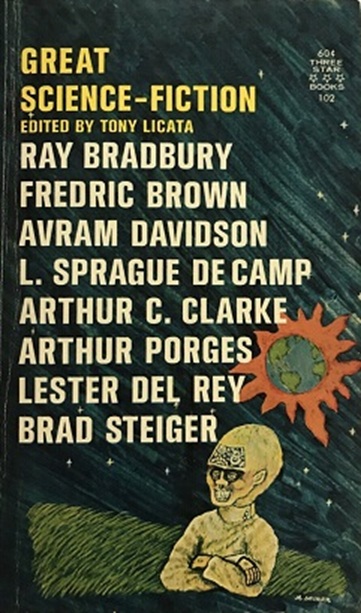
Book Review: Great Science-Fiction edited by Tony Licata
This anthology was, Wikipedia says, originally intended to have the title “Bizarre”, but that might have drawn the wrong kind of attention, so the publisher gave it this much more generic title.
“The Wind” by Ray Bradbury starts us off with a spooky tale of a man who claims to have found a valley in the Himalayas where the winds of the world gather their power, gaining strength and intelligence with each human they kill. But the viewpoint character is the friend he’s calling on the telephone. And as sympathetic as that friend is, he’s got a wife and company. He can’t always be going over to stay up with the man the wind is supposedly hunting.
And all those wind-related events, surely they are coincidence. Surely.
“Mouse” by Fredric Brown has a biologist who lives right next to Central Park witness an alien spacecraft land in that area. The only thing inside appears to be a dead critter that looks a lot like a dead mouse. But too late he figures out that there must have been something else in that craft. Something hostile.
“The Golem” by Avram Davidson is about an elderly Jewish couple sitting on their porch kvetching at each other when a gray-faced man comes up to talk to them. As it turns out, he is an artificial person, created by a scientist who failed to notice he was installing a sense of superiority with its mechanical brain. The visitor is trying to announce his plans to wipe out humanity, but the elderly couple has their own conversation going on, thank you very much. Perhaps the scientist should have installed knowledge of the tale of the golem.
“Judgement Day” by L. Sprague de Camp is the point where I realized I’d read this book before, as the story really stuck in my memory as a young reader. The narrator is a scientist who has discovered a method for creating a nuclear reaction in iron. Potentially, this could be used to cause a chain reaction in the earth’s crust, effectively destroying the planet. He now has to decide if he’s going to publish his findings.
We learn his backstory as a very smart but physically wimpy child, with some form of what we’d now call neurodivergence. He was mercilessly bullied for his “showoff” intelligence and lack of athletic skills. The adults in his life failed him, the closest thing to a solution they came up with was just pretending not to be bothered by the bullying so the jerks would eventually lose interest. So he built a cold shell of indifference that did over time stop the physical attacks mostly.
He’s been moderately successful in his work, though he stalled in rank because he does not get on well with people. And just recently, the boys in his neighborhood decided it would be hilarious to vandalize his home and car and paint insulting messages on his things. You know what, he’s old, he’s tired, and he hates the world, especially bullying boys, he’s going to publish.
As a very smart but physically wimpy child who was mercilessly bullied…I could relate.
“History Lesson” by Arthur C. Clarke is a two-part story. In the first half, one of the last humans on Earth discovers that there is no place left to run from the permanent ice age enveloping the planet. Humanity had never gotten beyond the Moon. His sons bury the few remaining artifacts of the civilization that once existed atop a mountain peak under a cairn just in case there will someday be someone who survived.
In the second half, Venusian explorers find the cache, which proves to their surprise that the Earth was once inhabited. They try to puzzle out what the inhabitants were like based on the few clues. Miraculously, one of those clues is a reel of film depicting the typical day in the life of such an inhabitant. But there is a twist, which means the Venusians will get the entirely wrong idea.
“The Ruum” by Arthur Porges begins with aliens accidentally leaving behind the title specimen collector on Earth set with certain parameters. They fail to go back for it due to being blown up in an alien war.
Millions of years later, uranium prospector Jim Irwin lands in the Canadian Rockies, looking for radioactives to mine. He’s not having much luck, so goes into an isolated valley. No uranium, but he does come across a bizarre collection of paralyzed animals including a small dinosaur. Then he sees the Ruum coming towards him, a metal needle dripping a green fluid that can’t be anything good.
The rest of the story is about Jim trying to escape the Ruum. The alien creature/device is slow but relentless and seemingly indestructible. Can Jim somehow survive without being permanently paralyzed in a collection no one is coming to retrieve?
This one’s exciting and has a logical ending established at the beginning.
“Dark Mission” by Lester del Rey opens with a spacecraft having crashed into a house. Two men are present, one dead and the other with complete amnesia. The living man knows he has a vital mission, but has forgotten all the details. Over the course of the story, he learns who he is, what his mission was, and why he needs to stop a rocket to Mars. By the end, it’s a rather sad story.
“A Better Rat Trap” by Brad Steiger is a bespoke story for this anthology. A scientist has developed a way to exterminate rats en masse without the use of poison and with minimal bad effects on the environment. But it needs refinement and testing. That’s why he’s come to this small town which has an abandoned mine swarming with the creatures.
Unfortunately for the scientist, he’s old, ugly and morbidly obese, and his insanely hot young wife married him for the money in his trust fund and any profit he might make off his discovery. His new lab assistant is conventionally handsome and in the prime of his life. Any fan of old-time radio mystery/horror shows knows where this is going.
And that’s the last in this short volume. It has a very Twilight Zone feel, unsurprisingly. You can imagine Rod Serling delivering epilogues to the episodes. “Judgement Day” is my personal favorite, but “The Ruum” and “The Golem” are also excellent, and the other stories are pretty good.
Most of the stories have been reprinted elsewhere, but this particular collection has a specific feel to it that makes it worth seeking out. Highly recommended to fans of the Twilight Zone and similar series.
