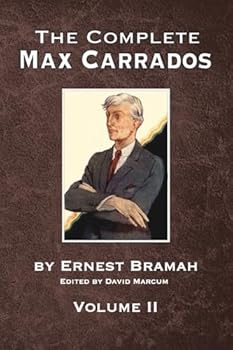
Book Review: The Complete Max Carrados Volume II by Ernest Bramah
Disclaimer: I contributed to the Kickstarter for this project.
To recap from my review of the first volume, Max Carrados is a blind detective published in stories from 1913-1934. A resident of a ritzy London suburb who’d been blinded in a riding accident, Max had developed his remaining senses to nigh-superhuman levels. They were popular back in the day, but have become obscure since the author’s death. Recently, a two-volume set collecting all the stories was published.
The first story in this volume is “The Secret of Headlam Height”, which takes us back to the days just before Germany officially declared war on Britain in the Great War. Max and his manservant Parkinson are on holiday near the title seashore location. Parkinson, whose visual memory is as sharp as Mr. Carrados’ memory for voices, recognizes the “Dutch” assistant at the local museum is actually a German military officer he’d seen some years before.
There’s a naval base not too far from the spa village, and it emerges that the German spy (for such he is) is sending coded signals to someone offshore by heliograph. There’s a murder and Max must figure out the spy’s plan so that Britain does not lose the war before they’ve even entered it!
One of the interesting things about the story is that the author speculates that what the reader of 2014 might want to know about what was going on in August 1914 isn’t necessarily what the people of 1914 considered important. He gives the example of a person needing change for a five-pound note having to buy five one-pound postal orders, then cashing them as something trivial to the time, but possibly shocking to someone a century hence.
Also of interest is guest character Clifton Baker, one of the most gifted translators and cryptographers in the world, who also happens to be a woman. She affects the airs of a frivolous flapper, at least partially to keep her male clients and colleagues from being too intimidated by her. She’s vital to cracking the German code.
Closing out the volume is The Bravo of London, the only Max Carrados novel. Master villain Julius “Toad” Joolby and his gang have been hired by the Comintern to create large denomination counterfeit British banknotes to flood the Asian market, harming the reputation and influence of Britain and capitalism in that area. They already have a skilled forger on board. But one more ingredient is needed, the authentic paper that Bank of England notes are printed on.
The paper mills that manufacture the special paper are in Tapsfield, a small village about an hour’s drive from the London suburbs. There are no accommodations for strangers in Tapsfield, and the town is small enough that any stranger is noticed instantly. Add on that the mills themselves are heavily guarded, and it would seem that stealing a sufficient supply of the special paper is impossible beyond a massive shootout that would spoil the whole secrecy part of the plan.
By a stroke of luck, Joolby has managed to recruit the one man who might be able to infiltrate Tapsfield’s mills, and the sinister plot moves forward. One problem, though. It just so happens that Max Carrados has a connection in Tapsfield, and is present on the day the infiltrator arrives. Can he unravel the gang’s plans and save the Empire?
Set in the summer of 1921 (the drought and heat wave that year are plot points), this novel rather abruptly reveals that Mr. Carrados has a living sister (unnamed), and a young adult niece named Nora Melhuish, as well as a nephew named Tom who’s away in the Alps at the time. Nora’s a plucky lass who has no compunction about donning leather trousers to ride a motorcycle to trail a criminal, and later goes undercover as a maid. (This does not work as well.)
We also learn that Max has in fact travelled the world, having been to Shanghai, Greece and various parts of Europe. And for the last few years, between his other recorded cases, he’s been instrumental in thwarting multiple Communist plots.
Mr. Joolby is…something else. A man of thoroughly mixed ancestry, he lost big in the genetic lottery. In addition to the facial features and general body shape that give him his derogatory nickname, he’s got withered legs so must get around on walking sticks, and is epileptic. Julius has never known the willing touch of a woman, children taunt him whenever out of his direct reach, and even the hardiest men prefer not to look directly at him. Is it any wonder that he prefers to leave his antique shop only under cover of darkness, and harbors a deep-seated grudge against the entire human race?
Which does not excuse his actions of course, but he never had much of a chance to be anything other than a victim or villain.
The closest thing Joolby has to a friend is his Chinese servant Won Chou, who initially seems to be a music hall comedy Chinaman who only speaks and understands pidgin English. But he’s either not repulsed by Joolby or able to hide that better than anyone else, and eventually we learn he’s not nearly the comedic figure he appears. Still comes across as a racist portrayal.
Then there’s Mr. Bronsky, the representative of the Comintern. For a Communist agent, he’s on the surface a pretty nice guy, full of universal brotherhood. He’s big on hugs and kisses for his comrades…though he draws the line at touching Joolby, demonstrating that Bronsky is not truly dedicated to the good of humanity.
I’ll leave the other villains to be discovered in the text.
Good: There’s plenty of twists and turns, plus moments of suspense and of humor. The characters are interesting, and the idea for the crime is novel.
Less good: A couple of important plot points are copy/pasted from other stories in the series, not so much a problem in a standalone novel, but disappointing if like me you just read those stories in the last month.
We skip over the actual heist to concentrate on what Mr. Carrados is doing, which admittedly is the main thing, but I wanted to see the actual plan in action after spending so much time with the criminals up to that point.
Content note: Suicide, a dog dies. Mr. Joolby is obnoxiously sexist, Max is genteelly so. Also see above about Won Chou.
Overall, it’s a good cap for the series, which leaves plenty of room for further adventures.
Other notable stories:
“The Curious Circumstances of the Two Left Shoes” is a light-hearted tale about a young couple who seem to have lost their silver. And for some reason, the wife has two identical left shoes, when she went to sleep with a normal pair by her bed. The couple has banter that wouldn’t be out of place in a Thin Man movie, and the “rational” explanation for the events is quite silly.
“The Strange Case of Cyril Bycourt” is notable for a couple of reasons, the first being that we get a little more information about Max’s youth, before he inherited his cousin’s money. He did not come from a well-off family, and despite graduating from a good school, had trouble landing a decent job. We meet a woman who seems to have fancied him back then, though her circumstances are modest now.
She’s worried about her nephew, and suspects that his stepmother may be trying to slowly poison him for the inheritance he will eventually be due. Mr. Carrados investigates, only to discover that the situation is way weirder than expected. This one verges on horror, and you might not buy the “science” involved.
“The Missing Witness Sensation” has Max Carrados go up against Sinn Fein as he’s the only witness who can prove one of their members did not, in fact, have an alibi for a post office robbery with a possible murder charge attached. The terrorists/freedom fighters kidnap Max to prevent him from testifying, but their leader is more the former than the latter, and fully intends to kill our blind detective if the trial goes badly. Locked in a cellar with seemingly no way to contact the outside world, how will Max survive? This one got turned into an episode of The Rivals of Sherlock Holmes, which you might be able to find a video of.
Overall, this is a good collection of stories about a quirky detective with a wide variety of cases. Most of the stories, except for The Bravo of London, are now in the public domain and can be found on the internet if you look, but to encourage further reprints of classic detective fiction, consider springing for this set.
