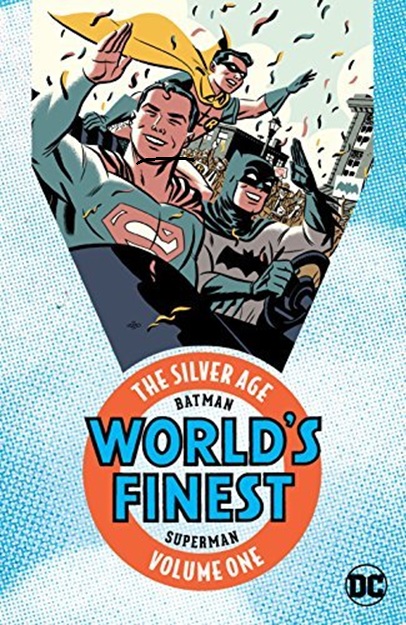
Comic Book Review: Batman & Superman in World’s Finest Comics: The Silver Age Volume 1 edited by Jack Schiff with various writers and artists
Superman was first published in 1938, with Batman following in 1939, swiftly becoming the two biggest sellers for National Comics, which would become DC Comics. Despite the obvious synergy potential of having the two team up in a story, this was not done until Superman #76 in 1952! That story was popular enough to float the idea of having a steady series pairing the Man of Steel and the Caped Crusader, and it happened that there was a perfect place to put it.
World’s Finest Comics had been running separate stories of Batman and Superman since 1941, and the covers often had the two with Robin the Boy Wonder in humorous situations. Since rising costs were forcing a page reduction, it made good economic sense to have one story combining the franchises. And thus was formed the World’s Finest team!
The “Silver Age” in the title of this collection, which has the Superman #76 story and those from World’s Finest #71 (1954)- #94 (1958), is a trifle misleading. That first story is at the tail end of the Golden Age of superhero comics, when superheroes fell out of fashion and sales of that kind of comics plummeted. The first few teamups happened pre-Comics Code, when crime and horror were in vogue. But the squeaky-clean, kid-friendly material DC specialized in was exactly the sort of thing that the Code allowed for, so almost nothing had to change in the Superman/Batman teamups. At the tail end of the stories we are moving into the Silver Age as the new Flash and Green Lantern comics set the stage for superhero revival.
So let’s take a look at some of the important/standout stories in this volume.
“The Mightiest Team in the World” written by Edmond Hamilton, pencils by Curt Swan, inks by John Fischetti, is that initial Superman story. Reporter Clark Kent and wealthy playboy Bruce Wayne are both going on a cruise on the Varania. Due to an overbooking mix-up, they’re assigned to the same cabin. (This was back when Bruce Wayne was merely rich, not a billionaire who could simply have bought the entire ship.)
Before the boat can cast off, a diamond thief sets a gas tank truck on fire as a distraction. Both Batman and Superman attempt to change outfits in the dark cabin, but a stray beam of light reveals their identities to each other. While Batman rescues Lois Lane, who’d of course headed directly towards the danger, Superman puts out the fire. But there’s no trace of the thief.
The heroes reason that the criminal must have slipped aboard the Varania as a passenger. So now to catch him, Superman and Batman must also be on the cruise, and Lois Lane, smelling a story, also wrangles her way aboard. Clark Kent is confined to his cabin by “seasickness” and Bruce Wayne is tending him. Lois is a bit suspicious, so Superman comes up with the idea of Batman flirting with the female reporter to distract her while a search is made. The heroes don’t realize that Lois is in earshot when they make that plan, so she’s playing along for giggles.
Batman and Superman eventually catch the thief and set up enough confusion to allay Lois’ suspicions about their secret identities. But she does get a little of her own back for the fake flirting plan by accepting a dinner date with Robin, to the men’s bemusement.
“Batman–Double for Superman” written by Alvin Schwartz, pencils by Curt Swan, inks by Stan Kaye, is the first World’s Finest installment. It briefly mentions the Varania incident, then has criminals come into possession of a hunk of Kryptonite. (At this point, Kryptonite was new and extremely rare.) To throw off the gang, Batman and Superman switch costumes, but this leads to Lois Lane temporarily suspecting Bruce Wayne is Batman!
“The Super Bat-man!” written by Edmond Hamilton, pencils by Curt Swan, inks by Stan Kaye, is the first story where Batman gains superpowers while Superman loses them. This version involves a criminal scientist who’s developed a supercharging ray that temporarily gives a person superpowers, and a separate decharging ray that takes them away. Eventually Superman figures out the latter is actually just a fine Kryptonite powder spray, enough to weaken but not kill him.
“The Three Magicians of Baghdad” written by Edmond Hamilton, pencils by Dick Sprang, inks by Stan Kaye, guest stars Dr. Carter Nichols, a scientist who has discovered how to send people back through time using the power of hypnosis. Not, mind you, send their minds back, send the actual physical people. He usually uses this on his friends Bruce Wayne and Dick Grayson to allow them to have adventures. But now he’s sent them back to ancient Baghdad and they’re not coming back, so Dr. Nichols calls in Superman to help. Superman, of course, can break through the time barrier on his own.
Flash back a bit, it turns out Bruce and Dick were supposed to have been investigating the myth of the Magnetic Mountain from the Arabian Nights story cycle. They did, only to discover that it was actually a massive magnetic meteorite that got them stuck and interfered with the recall signal. The pair, in their guises as Batman and Robin, were rescued by a young man named Aladdin, who was tricked into buying a worthless lamp on the promise it held a djinn.
The Dynamic Duo proceed to pretend to be actual magicians in order to trick Abdullah, the wicked false magician, into buying back the lamp. Just as it looked like they were going to be exposed, Superman arrives and starts pretending to be a genie. After shenanigans involving the Forty Thieves, our heroes return to the present.
“The True History of Superman and Batman” written by Edmond Hamilton, pencils by Dick Sprang, inks by Stan Kaye, has Ka-Thar, a historian from 5956, come back in time to force the World’s Finest team to redo some of their awesome feats differently to match the version in the book he’s written. And they have to do what he says or he’ll reveal their secret identities, known to everyone in the future. Ka-Thar is very careful not to let them see what’s actually written in the book, particularly the final chapter. That turns out to be because that chapter reveals that their secret identities weren’t revealed until long after 1956, and therefore his threat is hollow if he wants his book to be true. Lois, who’s been tagging along this whole time, is less interested in Superman’s secret identity than if she ever gets to marry the big lunk.
“Superman’s and Batman’s Greatest Foes” written by Edmond Hamilton, pencils by Dick Sprang, inks by Stan Kaye, is the first Lex Luthor/Joker team-up. They’ve both served their time and are out on parole. The mad scientist and clever jester claim to have gone straight, and are starting a legitimate business together. This business is the construction of “mechano-men”, human-looking robots designed to be nigh-indestructible and thus perfect for tasks too hazardous for flesh and bone workers.
Part of the plan is repeatedly making it look like Lex or the Joker is attacking normal humans, only for it to be a test for the mechano-men so that our heroes look silly for intervening.
Eventually, Superman and Batman figure out the villains’ real endgame, foil the plan, and the criminals are soon blaming each other for their failure. Dick Sprang’s pencils are key here for his particular rendering of the Joker.
“The Club of Super-Heroes” story by Edmond Hamilton, pencils by Dick Sprang, inks by Stan Kaye, introduces several new masked heroes from around the world. The Knight and Squire of England, the Musketeer of France, the Legionary of Italy, and the Gaucho of South America. These are all non-powered heroes who are summoned to Metropolis along with Superman, Batman and Robin, to be honored as the Club of Super-Heroes, complete with fancy headquarters. But there’s also a new hero in town, Lightning Man, who appears to be just as strong as Superman, but is never around at the same time.
The international heroes are barely in the story, to be honest, and would not be picked up for worldbuilding until much, much later. But this was a rare nod to the notion of non-USA superheroes for the time.
“The Super-Batwoman” written by Edmond Hamilton, pencils by Dick Sprang, inks by Stan Kaye, reintroduces Kathy Kane, the Fifties Batwoman. She’d been created to a) make a trademark claim, and b) serve as a potential love interest for Batman to ward off insinuations of homosexuality in the Batman/Robin relationship. In her first story, Batwoman had used primarily stereotypically feminine accessories as weapons, and been persuaded to temporarily retire the costume as crimefighting was too dangerous for women. (Sexism. You don’t gotta love it.)
But when a criminal who has access to temporary superpower capsules escapes from prison, Kathy figures that this is a big enough crisis that Batman won’t mind the help. (She’s a bit of a ditz.) As it happens, Batwoman is able to figure out where the power capsule is before the criminal can reach it, and gives herself 24 hours of Kryptonian-level powers.
She decides to use her new gifts to discover Batman, Robin and Superman’s secret identities so that they’ll see she’s capable, taking frequent breaks for crime and disaster fighting because she is after all a hero. Oh, and there’s a moment where she’s scared of mice because woman.
The male heroes manage to trick her, but as her borrowed powers fade, reluctantly agree that she can keep being Batwoman because there’s no realistic way of stopping her completely.
“Origin of the Superman-Batman Team” written by Edmond Hamilton, pencils by Dick Sprang, inks by Stan Kaye, is the final story in this volume. As I have mentioned before, back in the day it was expected that most comic book readers were children who would eventually move on, so the likelihood that they’d remember a story from four or five years ago, let alone be able to find a copy, was slim.
This story skips the cruise ship entirely as it revises elements of the first World’s Finest team-up, while in the present day Superman teams up with a new hooded partner called Powerman to protect him from Kryptonite rather than rely on Batman and Robin. Powerman, of course, is not what he seems to be.
Overall, this is a fun collection of short stories with some of my favorite DC characters. This series appears to have fallen into the Superman editorial bailiwick, so his supporting cast (especially Lois) is better represented. It’s also easy to see the strain caused by needing both the ludicrously powerful Superman and trained athlete Batman to be relevant in each story. Let alone poor Robin. The treatment of female characters isn’t the best, though Lois at least gets to be feisty.
This collection is in color, which drives up the price a bit. If you’re not a fanatical collector of Superman or Batman like me, you might want to check it out from your local library instead.
