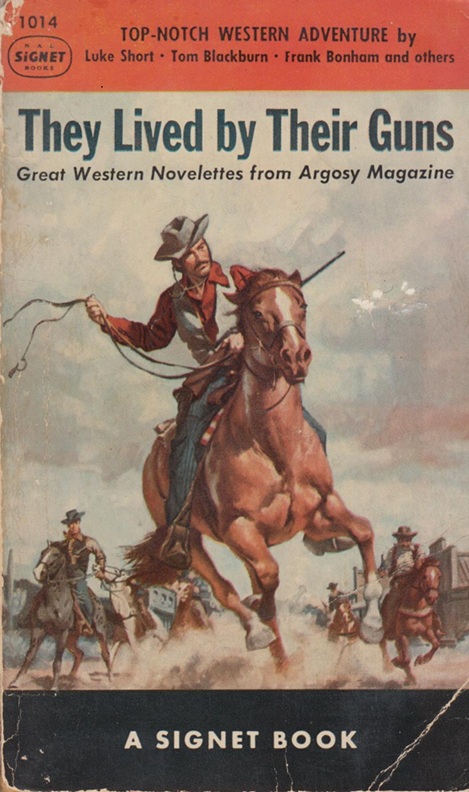
Book Review: They Lived by Their Guns by Various Authors
Back in the day, Westerns were king. Even pulp magazines like Argosy that weren’t exclusively western-focused tended to have at least one tale set in that genre every issue. Thus this collection of five novelettes reprinted from the magazine from the late 1940s, published in 1951.
“Trumpets West!” by Luke Short is our headliner, by the most recognizable author in the lot. Lieutenant Burke Hanna returns to Fort Akin in Arizona after a grueling three-week patrol with the men of K Troop. They’re starving, exhausted and some are physically injured. They’ve been sent out on repeated patrols without rest for months. But Fort Akin’s commander, Captain Ervien, is having none of that. He orders Lieutenant Hanna to take the men on another two-week patrol the next morning.
Hanna refuses, knowing perfectly well that Ervien is punishing his men because he found evidence that Mr. Alec Corrine, the Indian agent, has been shorting the natives on the local reservation of food and overcharging the government. Problem is, Ervien is engaged to Corrine’s daughter, and won’t heard a word against him.
As a result, Hanna is confined to base. He talks to his fiancée, Calla, the daughter of the fort adjutant officer, but there’s little that can be done. She indicates that she’d like to go ahead with the wedding regardless of his current military status.
Meanwhile, Ponce, the Apache Hanna’s patrol had convinced to return to the reservation, is about to go awol again because conditions are no better than they were when he and his renegades escaped the last time.
Hanna interferes with the beatdown of one of his troopers by a bully, and is put in the guardhouse. But when the natives go on a rampage, he’s the one man who can lead the troops to victory…or a massacre.
This is a relatively rare look at corruption in the cavalry for the time period, though it does work out that the majority of the troopers are honest people who are just doing their job and the oppression of Native Americans is not questioned.
“Renegade” by Tom W. Blackburn stars Jim Henry, a hermit who’s friends with the local Arapahoe, including old chief Antelope. A wagon train is moving into the Poudre Valley. The wagon master, Aaron Baring, is arrogant and openly racist. When Jim tries to lead negotiations between the Arapahoe and their new neighbors, Baring declares that the settlers will be taking the entire valley, thank you, and the Indians will just need to find some other place to live. Maybe, if it turns out there are some worthless bits of land, those scraps can be turned back over to the natives at a later date. And Baring plans to use lethal force to enforce his will.
The Arapahoe leave disgruntled, but Jim stays to try further negotiation. Baring instead has Jim tied up and whipped before tossing him in a wagon so he can’t cooperate with the Arapahoe to assemble a resistance. This disgusts both the wagon train’s most respectable citizen and the woman Baring intends to marry, but the wagon master’s word is law until the end of the voyage.
The woman, Sue “Lucky” Duneen, has by now realized that a relationship with Baring is nothing to desire, and helps Jim escape with her and a passel of good horses. Jim’s motives are a mystery to her, though, as she’s only seen men at their worst in her entertainment industry job. She also explains that Baring wants the Arapahoe to attack the wagon train. The ex-military man has a troop of American soldiers hanging back a day’s travel back.
The plan is to have the natives attack the wagon train, kill a bunch of the settlers, then have the army attack the Arapahoe and wipe them out to spark a race war. The clock is ticking–can Jim find a way to save lives, both of friend and enemy?
“Trouble at Temescal” by Frank Bonham takes place in California, a territory recently acquired by the United States. Horse traders Hank Ashwood and Red Wolfe have brought a string of good mounts over the mountains and desert in hopes of a decent payday. They accidentally become involved in local real estate issues.
Mexican landowners are being forced off their holdings by American squatters with dubiously sourced deeds–the new American courts strongly favor American deeds over Mexican ones, even if the landowner has been on the property for decades. Julia de la Torres is one of those Mexican landowners, a recent orphan with no husband to support her claim.
Hank is offered the chance to help Julia save her rancho with a false marriage. If she has an American citizen husband, her deed will be recognized. He can then vacate California; after a couple of years, she’ll be able to file for annulment on grounds of desertion, but her land claim will still stand. Hank thinks too highly of the sanctity of marriage to consider this dodge, but Red is less scrupulous.
Unfortunately, that lack of scruples means that Red doesn’t hold up the part of the bargain where he leaves, and things get dicey from there.
“Powder, Shot and Texas Cattle” by Allan R. Bosworth concerns Charley Greer, a cattle shipper in Dodge City, Kansas. He’s an honest fellow who came up from herding cows himself, but there’s a problem. A rival dealer named Corbin has been using unscrupulous methods to steal contracts for the cattle drives coming in, such as getting people drunk and into fixed card games. Charley would love to just shoot Corbin and be done with it, but Corbin conspicuously refuses to wear a gun and has his dirtier work done by underlings.
When Charley tries to intervene to save a foolish young man from being cheated, he gets into a gun fight with a very drunk henchman of Corbin’s, who dies. Since all the witnesses are Corbin’s men, Charley has to hightail it out of town. He winds up assisting the cattle drive of Betty Larrabee, a young widow whose previous foreman had nearly killed the cows with his incompetence.
Corbin’s not going to give up that easily, and Charley has to find a way to save Betty’s drive, clear his name, and force that final showdown.
“The Man at Gantt’s Place” by Steve Frazee stars Lew Gantt, a young fellow who’s grown up on the horse ranch of his father, Stump Gantt. Stump is a cautious long-term planner with a lot of patience, which has earned him the respect of those of his neighbors who pay attention. But it also makes life on the ranch boring for a late teenage aged boy who’s feeling his oats and has never been anywhere by himself.
So Lew gathers his meager nest egg, saddles up, and heads out on his own. His parents don’t argue this, knowing that doing so would just make Lew pig-headed. Lew arrives at the nearest town, walks into the saloon, has his first drink of whiskey, and participates in his first poker game with real stakes.
A combination of already being trained in the game by a friend of his father’s and beginner’s luck results in a fairly large winning pot for young Lew. Unfortunately, one of the other players is a poor loser, and Lew also winds up in his first gunfight, and more by luck than practice getting his first kill.
This sickens the boy, no born murderer he. Drifter Smoky Cameron, who was also in the game, steadies the lad and makes sure he gets his winnings. They become friends.
A few days later, Lew discovers that gambling is not his best choice of career when he loses all his money in successive games. He starts doing labor for the “nesters” in the area, re-evaluating what he thought he knew about the conflict between the homesteaders and ranchers in the valley. That conflict comes to a head as Smoky’s real identity is revealed. At the end, Lew is a man who can return to Gantt’s place.
Unlike the other stories in this volume, there’s no romance subplot for Lew. The romance happens to someone else off-page.
These five stories manage to show how much variety you can get out of “men with guns in the Old West.” Their portrayal of Native Americans is more nuanced than the pulps of the 1930s, but not yet up to more modern standards. Also, period sexism; women are allowed to be strong-willed and sharp-tongued, but men get all the action sequences.
It doesn’t look like this volume was ever reprinted, though Luke Short is notable enough that his story might have been collected elsewhere. If you’re a Western fan who enjoys the 1950s style of story, try your local used book store.
