Comic Book Review: Karl the Viking Volume II: The Voyage of the Sea Raiders stories by Ted Cowan, Michael Moorcock; art by Don Lawrence
Karl is Saxon by birth, sometime in the 11th Century. He was adopted early in his youth by Danish chieftain Eingar the Manslayer, who’d been impressed by his father’s courage. Karl grew to accept the ways of the Vikings, and eventually became a chieftain himself, combining the best aspects of Briton and Scandinavian warriors. Now he leads his Viking crew to glory and treasure, battling men, monsters and magic!
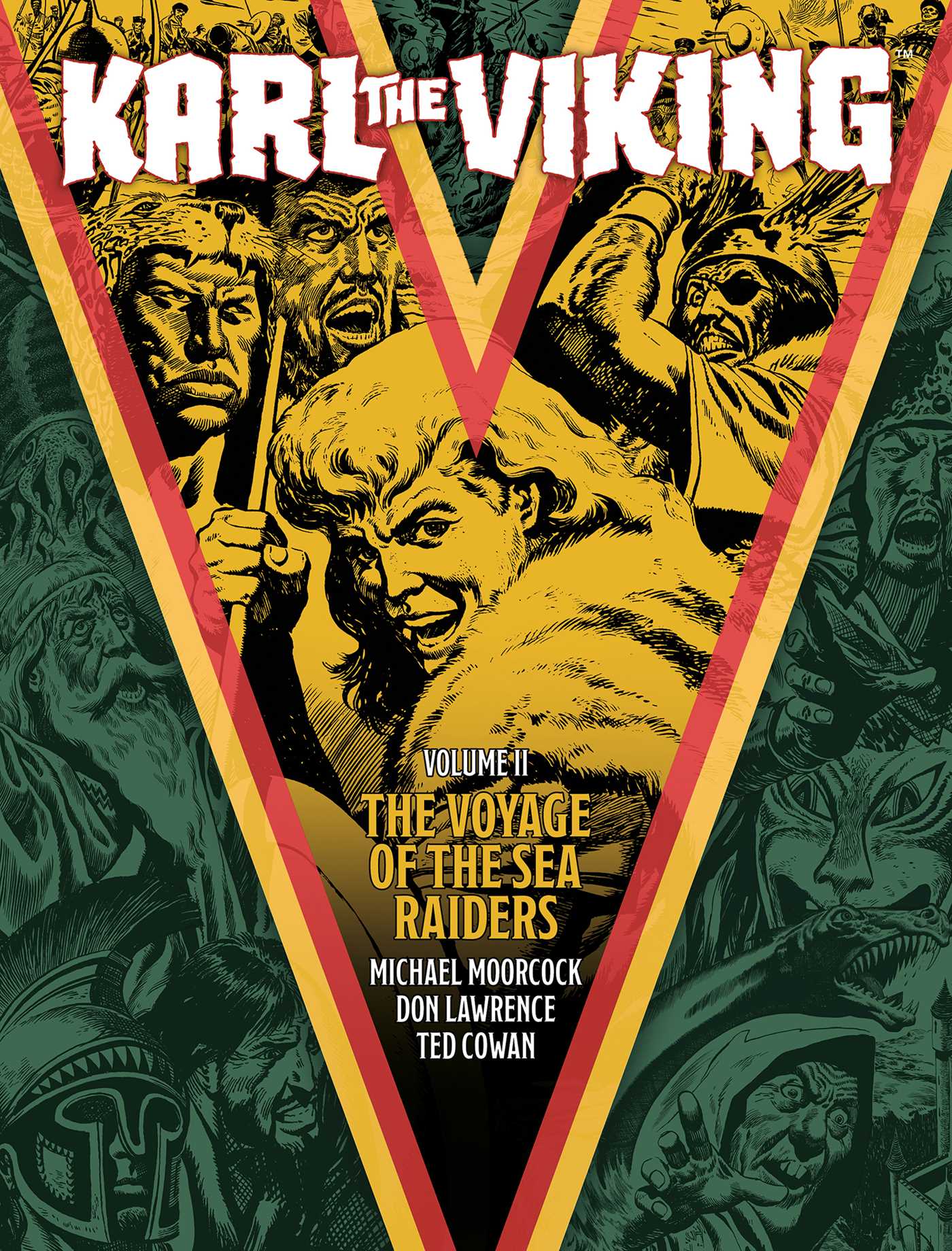
This British comic series ran in Lion from 1960-1964, with a few stories in later annuals. The writer for most of the series was Ted Cowan, who previously created the Robot Archie series. A story towards the end of the original run was written by Michael Moorcock, who became famous for (among other things) Elric of Melnibone. The primary artist was Don Lawrence; some color work he did for the annual stories got him selected to work on The Rise and Fall of the Trigan Empire.
This volume opens with a two-part story about Karl’s rivalry with the cunning Gefion One-Eye. First they compete to collect treasure from a Saracen caravan, then they must cooperate to battle the Kraken, a seemingly invincible sea serpent. Gefion’s cooperation is…lacking, and eventually the two men duel to the death on the Kraken’s back.
Next up, a long story set in Ireland, as Karl must battle Moru the Sorcerer, a mage with a machine that induces mass hypnosis. Moru plans to use a mesmerized army, including Karl’s own men, to make himself king of the Emerald Isle. Karl and his most faithful men, Sweyn and Ajarn, though vastly outnumbered, must find a way to stop the would-be usurper.
This story has the only relevant female character, an unnamed aged witch who is Moru’s sworn enemy. While her powers are far less than the sorcerer’s, she repeatedly aids Karl by guiding him to secret (but dangerous) shortcuts, and at the end casts an illusion to distract the evil mage at a critical moment.
Then there’s a tale in which Karl’s crew sees a falling star, and the Thor-priest aboard has a vision that reveals that where it landed is rich in diamonds. (The gods commonly invoked here are Thor of the wind and storm, Odin of wisdom and leadership and Loki of fire (no mention here of trickery or evil, but Karl is most prone to speak of Wyrd, the fate that dooms all men.) Naturally, Karl and his crew are all for going after the diamonds.
Unfortunately, this involves going deep inland to a place no Viking has ever trod before, and the merciless Talga and his Mongol warriors have also learned of the diamonds. Karl manages to get to the diamonds first, but Talga’s men have burned the Viking ships and laid traps along the most likely routes out of the land.
This means a long overland trek through unknown territory, encountering many strange civilizations and creatures before finding their way to Russia and people who know the way to the coast. The diamonds enrich Karl’s tribe, but he’s soon restless for adventure again.
Which brings us to the storyline that this volume is subtitled for. Rival chief Orfin arrives one stormy night to announce that he’s acquired a mighty wrestler, and challenges Karl to face this warrior. Despite evil omens, Karl is not one to back down from any challenge, and accepts the match at a neutral location.
The wrestler is the mighty Tava, Breaker of Backs, a fellow from a large island off the coast of sub-Saharan Africa. It’s a close thing, but Karl’s skill prevails. Impressed by Tava’s might, he buys the African’s life from Orfin, and in “gratitude” Tava promises to lead Karl to a great treasure hidden on his home island.
Tava in truth has a wicked heart, and his actual plan is to set Karl and Orfin against each other in the quest for the treasure. The treasure is concealed in a place that is insanely dangerous to enter, but includes the regalia that will allow Tava to claim leadership of his tribe. Once he has that, Tava will be able to use his warriors to wipe out whichever remains of Karl or Orfin.
Karl manages to escape with his life and at least some of the treasure, having earned both the admiration and hatred of Tava.
“The Quest of the Long Ships” is the Moorcock story. Olaf, Jarl of Rogaland in Norway, is dying. Chieftains from all the Viking lands gather to pay him respects. In his last words, Olaf tells Karl that his intended heir is the long-vanished Sigurd, who sailed west to Vinland and never returned. Karl vows to sail and find Sigurd to bring him back. Haakon of the Red Hair, Olaf’s next-nearest kin, is furious at this news, as he expected to be named the next Jarl.
It’s a deadly race across the North Atlantic to the Viking settlements in the New World, as Haakon tries dirty trick after dirty trick, and the navigation hazards are against the voyage. And even when Vinland is reached, the native Skraelings are hostile and ready to enslave or slaughter all the invaders.
This story introduces a younger brother to Karl, Sven, who is presumably also adopted. He’s mostly there to be in peril.
The volume then collects the stories from the annuals. The closing story is “The Sword of the Sea Wolves.” The currently highest-ranking chieftain of the local Vikings, Skuld, decides to take The Golden Hammer of Thor, his symbol of office, with him on a voyage to distant Thulia. Karl argues against it, as losing the hammer would bring shame upon the Vikings. Skuld scoffs, after all, he’s awesome and would never lose the hammer. Karl can do nothing further, as Skuld has an absolute right to take his property with him.
Naturally, Skuld’s ship is wrecked by sea monsters, and Karl must mount a rescue mission to Thulia to recover the chieftain and the golden hammer. Karl once again shows himself the greatest of all Vikings.
Good: This is exciting action with good black and white (mostly) art. There’s enough variety in the stories that it doesn’t get old. While there’s some period ethnic prejudice and use of archaic epithets, the use of the various cultures is not nearly as painful as was common in the era. The lack of relevant women means no annoying romantic subplots.
Less good: The characterization of most of the characters is paper thin. Karl is a dashing hero who is perhaps a little too reckless, his crew is either brave or terrified depending on the situation, and most of the villains are one note baddies. Tava is the notable exception, as he has layers to his sneakiness and seems genuinely to like Karl even as he schemes the Viking’s destruction.
Historical accuracy is…limited, even given the fantasy elements, with horned helmets, just kind of ignoring the domestic side of Danish Viking culture, and slavery only being mentioned in connection with Vikings being enslaved by a particularly evil Arab. And of course the moral implications of the sea raider lifestyle are never brought up.
Content note: Lots of violence, often lethal, almost always non-graphic. Some ethnic prejudice, animals die. This was aimed at schoolboys when published, and most middle schoolers should be able to handle it.
This is a fun bit of nostalgia for British comics fans. Recommended for Viking enthusiasts who are okay with minimal historical accuracy.
