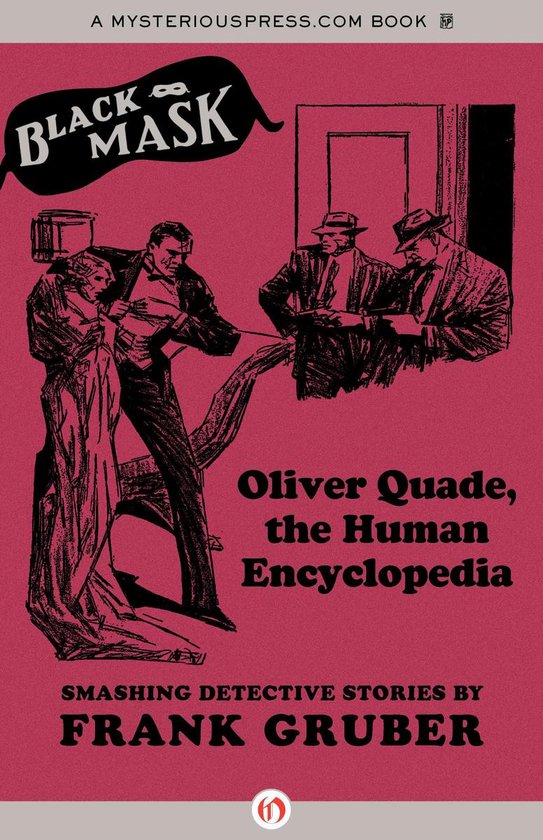
Book Review: Oliver Quade, the Human Encyclopedia by Frank Gruber
Oliver Quade is a traveling salesman, specializing in books, and in particular The Compendium of Human Knowledge, a thousand-page condensed encyclopedia. His sales gimmick is that he has an eidetic memory, able to retain every fact he’s ever read, and Mr. Quade is a prodigious reader. Once having found a group of people, he starts his pitch by offering to answer any factual question, from the common to the most obscure. When he wows the rubes with his vast command of trivia, he offers the Compendium for sale at the bargain price of only $2.95.
Which is great, but he also has a habit of being nearby when murders are committed, and a combination of ego and being a possible suspect requires him to solve them. Good thing he’s got that memory!
Frank Gruber was born in Minnesota, though like most celebrities Minnesota claims, got his fame elsewhere. After early struggles, Mr. Gruber found a winning formula for writing mysteries and westerns for the pulps, becoming a mainstay of Black Mask. After the pulp market started drying up, Frank moved to Hollywood and did well in the movie and television business (his last movie credit is White Comanche, which I’ve reviewed here.) He also wrote a bunch of novels, and a book about working in the trade, The Pulp Jungle (1967).
Oliver Quade was his first series character, running from 1936-1940. This volume reprints eleven of the fifteen stories. (It’s not discussed why the other stories were left out.)
“Death at the Main” is actually the second Quade story, but we’re skipping “Brass Knuckles” for some reason. Oliver has managed to slip into the crowd at an illegal cockfighting event being held by Long Island millionaires. When there’s a lull between matches, he starts his spiel, and cleverly wangles not getting thrown out.
We learn as much as we’re going to about Quade’s background before becoming a salesman here; he was born and raised in the South, and at one time bred fighting chickens. We also learn he’s a very successful salesman, pulling in over $20,000 a year. (But this is the last time we’ll hear of him saving any of it.)
One of the wealthy poultry owners is murdered, and it’s up to Oliver to figure out how it was done, and who did it. There’s an exciting scene where Mr. Quade is trapped in a small feed shed with an enraged and fully equipped rooster by the murderer.
“Ask Me Another” continues the chicken theme, as Oliver Quade plies his trade at a poultry show. We’re introduced to Charlie Boston, Mr. Quade’s sidekick, who’s not quite as bright but is strong and helps lug around the heavy cases of books.
We’re also introduced to what will become a running theme in these stories. The two men are broke because they haven’t actually sold anything recently, and the hotel manager wants his back rent by tonight or they are out on the street. Oliver is a fan of nice hotel rooms and fancy dining, while Charlie plays the horses with less than average luck.
So, it’s off to the poultry show, do or die. Except that it’s one of the chicken breeders that dies, strangled by poison gas. Which somehow no one at the show noticed. Can Quade solve the crime and make enough cash sales to avoid being out on the street?
“Rain, the Killer” switches up the formula a bit. We get to see the murder from the murderer’s perspective at the beginning, though we don’t learn anything about the perpetrator themselves except that the person is schizophrenic.
Oliver Quade comes in because he’s driving from one place to another in the middle of a rainstorm. He comes to a rickety bridge and two men in a heavier car need help getting across, so helps them out by driving them across in his car. Only afterwards does he find out they’re the sheriff and a deputy investigating a death, but Oliver’s game to get them to the isolated island mansion where the crime happened.
Things take a turn for the much worse when the dam breaks upstream, both the bridges are washed out, and the murderer sets the mansion on fire! The situation becomes a matter of survival, as well as detection.
This one’s notable because Oliver builds (with help on the physical labor side) a functional medieval catapult with scrap materials, and also demonstrates no compunctions about killing to save lives.
Content note: This is a very 1930s understanding of schizophrenia.
“Death on Eagle’s Crag” takes place at a mountain resort in the Catskills early enough in the season that it’s not fully open yet. Oliver Quade is still trying his luck with the few guests, much to the irritation of the resort owner, when there’s a report that one of the guests has died of a rattlesnake bite.
Naturally, it takes one look at the two corpses, man and snake, for Quade to tell it’s actually murder. Before the cops can be summoned (there’s no phone at the resort), a carload of escaped mobsters shows up and takes over the place. The head mobster is willing to let Oliver try to solve the murder though, as it’s learned there’s a pile of hidden money the victim had.
“Dog Show Murder” takes place, well, at a dog show. After Oliver plays a practical joke that creates a lot of noise and running around, Charlie Boston finds a corpse lying in their booth. The police are forced to admit there’s no known motive and Quade would be incredibly stupid to leave a murder victim in a place that points to him, but there’s still a lot of suspicion.
This story also introduces Christopher Buck, who’s billed as “the world’s greatest detective” but is not in fact that person. He’s not stupid though, and is just sharp enough to make trouble for Quade, who can’t help winding him up.
This is the only Oliver Quade story to be adapted for a movie, The Death of a Champion (1939), but it was a very loose adaptation, which killed off a dog instead, and apparently bombed.
“Death Sits Down” takes place in a factory. Oliver Quade is pitching his book to the workers during lunch break when suddenly everyone sits down and the doors are closed. He’s stumbled into a strike, and the union won’t let him leave! Worse, one of the owners of the factory is found dead, and they can’t let the outside world know since that would allow the owners to send in violent strikebreakers on the grounds the workers have committed murder.
This one has a rather sappy romantic subplot between the head of the strikers and the daughter of the main owner who has been working in the factory under an assumed name to be close to him. The story brushes against political themes, but doesn’t commit.
“Forced Landing” takes place in rural Wisconsin, not far from Spooner. Quade and Boston are driving up to Duluth to sell books at the Ice Festival, but their car runs over a fox, and then runs out of gasoline. Stranded, they head towards the nearest farm, which turns out to be a silver fox fur farm. The pinchpenny owner is not glad to see them, especially as they’ve killed off one of his prize foxes, and doesn’t have a phone.
Before Oliver can figure out a way to avoid being turned out into the cold, more people show up. This small assortment is from a plane that had to make a forced landing nearby, which is bad enough, but after the landing, the pilot was found with a bullet wound in his head.
And to make matters worse, some gangsters show up to rob the farm of its furs!
Oliver Quade is at one point locked in a small room with an enraged fox and sadly has to kill it.
“State Fair Murder” takes place at the Minnesota State Fair! (Not seen on this blog since Murder on a Stick.) Oliver is told he can’t do his pitch inside the Education Building, as he didn’t pay the extra fee for a booth inside, so he has to do his spiel outside. He doesn’t get too far before a man in the crowd dies from a poisoned dart (stolen from a Midway game, not a South American blowpipe thing.)
The man turns out to be a local publisher of history textbooks, and Quade’s knowledge of historical facts turns out to be more relevant than usual. We also see Oliver display his knowledge of, and ability to exploit, various carnival scams.
The local color endeared this one to me, though I was more impressed before I found out the author came from Minnesota.
“Funny Man” takes us to Hollywood. Oliver Quade is doing his spiel outside a studio when the studio head sends a guard out, not to chase him away, but to offer him a job! It seems that the voice actor for Desmond Dogg is not available, and the studio head thinks Quade has the right vocal qualities to take the role. It’s out of his usual line, but Oliver is broke again, so takes the offer for this one time.
But on the same day, another executive at the lot is murdered, and Oliver happens to find the body under suspicious circumstances. Uh-oh!
We learn a bit about how animated cartoons are made, and other Hollywood knowledge. There’s a recently released gangster who might be mixed up in this somehow, and Christopher Buck is back, as the murdered man was his client–though the man was killed before explaining what he needed Mr. Buck for.
“Oliver Quade at the Races” has Quade and Boston at their lowest. They haven’t made a sale in over a month, and the hotel bill is higher than they can pay even if they sell their entire available stock in the afternoon. A man overhears their desperation and offers them a quick job.
He needs to get a letter hand delivered across town, but he’s being shadowed by two rather large gentlemen. He can offer our broke salesmen twenty dollars in advance to get the letter into the hands of the recipient. Quade can think of multiple ways to parlay a double sawbuck into more money, so agrees.
Oliver and Charlie are pretty good scrappers, and manage to clobber their tails. But when they arrive at their destination, the guy who was supposed to get the letter is already dead, murdered!
Oliver Quade suggests going to the racetrack with their remaining funds from the twenty, ostensibly to gamble, but also because he knows that the person who sent the letter is going to be there. Charlie Boston’s “system” turns out to be terrible, but Oliver spots the man he wants, only to have him be dead by the time Quade gets across the room to him!
Oliver’s going to have to do some fast talking and thinking to get out of this one alive, free and not broke.
“Words and Music” brings our salesmen back to New York City. They meet a young man in a bar who claims to be a songwriter, and to have just published a big hit. Oliver and Charlie are understandably skeptical, and the man is clearly drunk, pushing sheet music on the piano player to play. And then the self-proclaimed songwriter drops dead!
It’s poison in his beer, and the obvious suspect is “Soup” Spooner, a criminal chemist. But what’s the motivation, and who is Soup working for? Oh, and where did the sheet music go?
Quade is able to leverage both his knowledge of chemistry and scams to good effect. By this time, the police officer actually has knowledge of Oliver Quade by reputation, and has a quirk of his own, playing the trombone. This is a plot point.
Content note: Early 1940s depiction of mental illness.
There’s also an introduction which explains the premise and importance of the story series, an article on how a group of writers including Gruber and a new editor revitalized Black Mask, and a short piece by Frank Gruber describing how “Funny Men” came to be and his hopes for the “Dog Show Murder” movie.
These are fun stories with some humorous elements and plenty of knowledge bits you can use to impress your friends (double check though as some of them are obsolete.) Oliver is a likeable protagonist, generally a good guy but a bit of a scallywag who isn’t afraid to sass cops and other authority figures when he can get away with it.
There are some reused bits that become more obvious when these are all read together. Quade gets shot in the left shoulder three separate times! (And none of these is mentioned in future stories.)
I enjoyed this volume, but it is spendy, so unless you’re a pulp collector, you might want to see if you can get it from your library or the ebook edition. The missing stories might be available somewhere on the internet legally.
Recommended for fans of trivia, pulp mysteries, and traveling salesmen.
